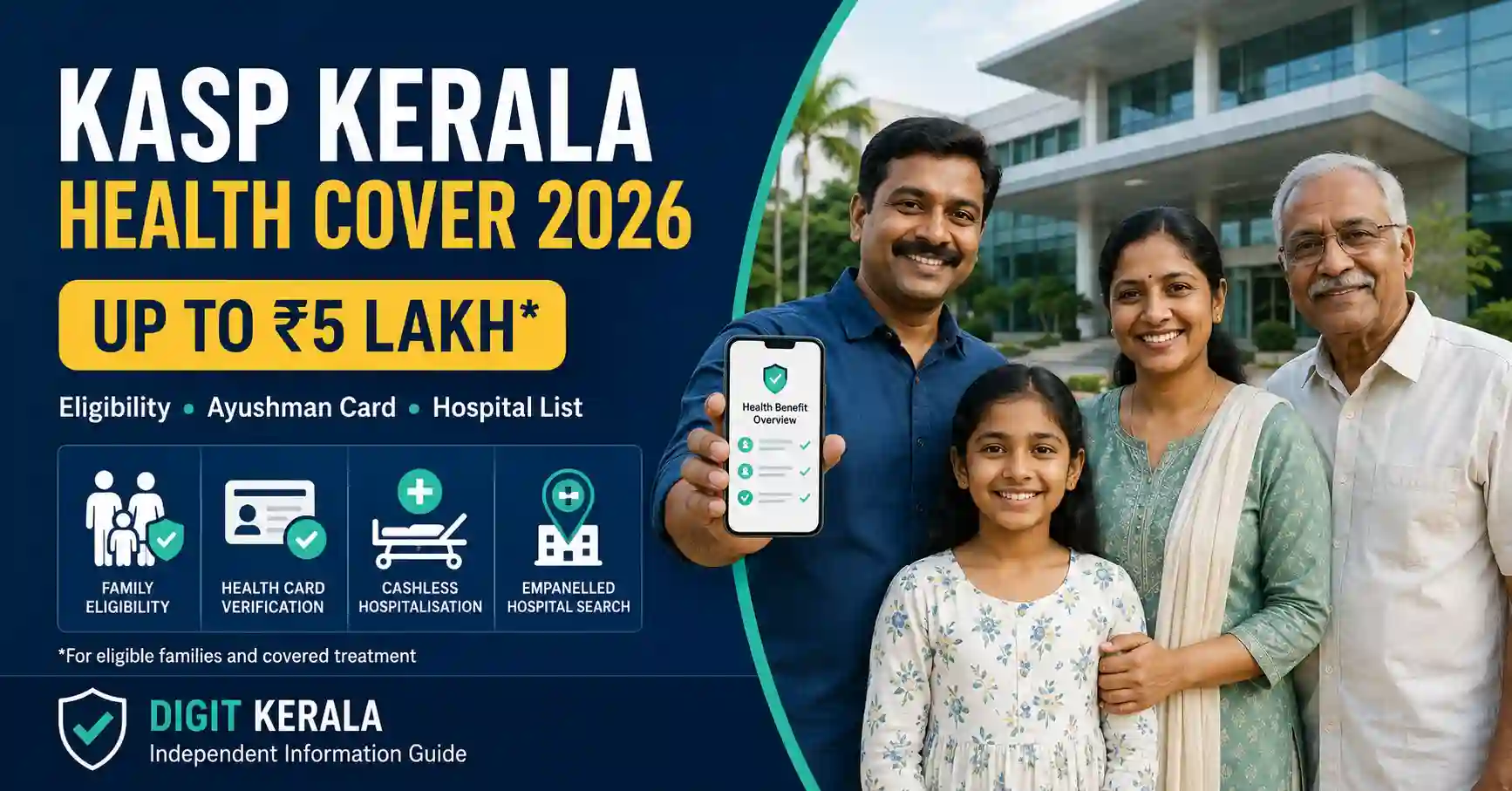
Karunya Arogya Suraksha Padhathi, commonly known as KASP, is Kerala’s implementation of the Ayushman Bharat Pradhan Mantri Jan Arogya Yojana health-assurance programme.
KASP–PM-JAY provides eligible families with cashless coverage of up to ₹5 lakh per family per year for listed secondary and tertiary hospitalisation treatments at empanelled public and private hospitals.
The benefit is provided on a family-floater basis. One or more eligible family members can use the available coverage, subject to the annual limit, approved treatment packages and scheme rules.
This guide explains Ayushman Bharat KASP Kerala eligibility, beneficiary checking, Ayushman Card generation, documents, empanelled hospitals, cashless-treatment procedure and important fraud-prevention precautions.
Important: KASP does not provide ₹5 lakh as a direct cash payment to every family. Only families included in the eligible beneficiary database can use the scheme, and only approved treatment packages at empanelled hospitals are covered.
What Is KASP Kerala?
Karunya Arogya Suraksha Padhathi is a government-funded healthcare-assurance scheme implemented by the Kerala State Health Agency.
It combines eligible beneficiaries under Ayushman Bharat PM-JAY with applicable Kerala government-supported health-protection programmes.
The scheme is intended to reduce the financial burden of eligible families requiring secondary or tertiary hospitalisation.
The main features include:
- Health coverage of up to ₹5 lakh per eligible family per year.
- Cashless treatment at empanelled hospitals.
- Public and private empanelled hospitals.
- Family-floater coverage.
- No general restriction on eligible family size, age or gender.
- Coverage of eligible pre-existing conditions from the first day.
- Portability across PM-JAY empanelled hospitals in India.
- Coverage for listed treatment packages.
- Up to three days of eligible pre-hospitalisation expenses.
- Up to 15 days of eligible post-hospitalisation expenses.
Treatment remains subject to package availability, medical necessity, beneficiary verification and hospital authorisation.
Is ₹5 Lakh Paid Directly to the Family?
No. The ₹5 lakh amount is not transferred to the family’s bank account.
It represents the maximum annual family-floater cover available for eligible hospitalisation packages.
When an eligible beneficiary receives an authorised cashless treatment:
- The hospital verifies the beneficiary.
- The treatment package is identified.
- Required pre-authorisation is obtained.
- The hospital provides the approved treatment.
- The hospital submits the claim through the scheme system.
The patient should not normally be required to pay the hospital for items fully included in an approved cashless package.
However, unrelated services, non-covered items or treatment outside the approved package may not be covered. Obtain clarification from the hospital’s KASP help desk before treatment.
Who Is Eligible for KASP?
KASP–PM-JAY is not an open health-insurance policy that every Kerala resident can purchase or join automatically.
Eligibility is determined using the beneficiary databases and criteria approved under the scheme.
These can include:
- Eligible vulnerable families identified through the applicable socio-economic database.
- Families previously included under eligible government-sponsored health schemes.
- Families verified and approved through the Kerala State Health Agency system.
- Other beneficiary categories added under applicable government decisions.
Possessing a ration card, Aadhaar card or low-income certificate alone does not automatically prove KASP eligibility.
The applicant’s name or family record must be available and verified in the authorised beneficiary system.
How to Check KASP Eligibility Online
The National Health Authority provides an official beneficiary portal:
Ayushman Bharat Beneficiary Portal
Follow the current on-screen process:
- Open the official beneficiary portal.
- Enter an active mobile number.
- Complete OTP verification.
- Select Kerala.
- Select the applicable scheme when requested.
- Search using one of the available identification options.
- Review the family and beneficiary details displayed.
- Complete identity verification when required.
Available search options may include:
- Aadhaar number.
- Ration-card or family information.
- PM-JAY family ID.
- Beneficiary name and location.
- Another identification method displayed by the portal.
Portal options may change. Follow the current instructions displayed on the official website.
If no record is found, it does not necessarily mean that the person’s medical condition is ineligible. It means the beneficiary record requires further verification.
Other Ways to Check Eligibility
A person can also request assistance through:
- The Ayushman help desk at a KASP-empanelled hospital.
- An authorised Common Service Centre.
- Kerala State Health Agency support.
- Ayushman Bharat helpline.
- Arogya Mitra or KASP kiosk at a participating hospital.
Official helpline numbers include:
- Kerala health helpline: 1056
- Kerala State Health Agency: 0471 4063121
- National Ayushman Bharat helpline: 14555
Telephone numbers and service timings can change. Verify them through the official SHA or NHA website.
Ayushman Card and KASP Card
The Ayushman Card is used to identify and verify an eligible beneficiary under the scheme.
Generating a card does not create eligibility for a person who is not already entitled under the approved beneficiary system.
The card can help an empanelled hospital:
- Identify the beneficiary.
- Verify scheme eligibility.
- Access eligible family information.
- Process an approved treatment package.
- Maintain treatment and claim records.
Do not treat the card as a general medical insurance policy covering every hospital expense.
How to Generate or Download an Ayushman Card
Eligible beneficiaries may use the official beneficiary portal or obtain assistance from an authorised hospital kiosk or CSC.
General online steps include:
- Visit beneficiary.nha.gov.in.
- Sign in using the available mobile and OTP method.
- Select Kerala and the applicable scheme.
- Search for the eligible family.
- Select the correct family member.
- Complete the identity-verification or e-KYC procedure.
- Submit the requested information.
- Wait for approval when verification is required.
- Use the download option when the card becomes available.
Do not select another person’s family record simply because the name is similar.
Documents That May Be Required
Beneficiary verification may require:
- Aadhaar card.
- Ration card.
- Registered mobile number.
- Existing KASP or Ayushman Card.
- Family or beneficiary ID.
- Another government identity document.
- Address information.
- Family-relationship proof when requested.
- Recent photograph or live photograph.
- Medical referral or treatment records when applicable.
Document requirements can vary depending on the beneficiary record and verification method.
Carry original documents when visiting a hospital or authorised centre. Submit copies only through verified channels.
What Does the ₹5 Lakh Cover Include?
For authorised treatment packages, the coverage may include applicable expenses such as:
- Medical examination.
- Specialist consultation connected with hospitalisation.
- Hospital accommodation.
- Nursing care.
- Medicines and medical consumables.
- Diagnostic and laboratory tests.
- Intensive-care services.
- Operation-theatre charges.
- Surgeon and physician charges.
- Approved medical implants.
- Complications arising during the covered treatment.
- Eligible pre-hospitalisation expenses.
- Eligible post-hospitalisation follow-up.
The exact coverage depends on the package authorised for the patient.
The hospital should explain the approved package and any non-covered item before obtaining payment from the beneficiary.
Pre-Hospitalisation and Post-Hospitalisation Cover
The Kerala State Health Agency states that eligible packages can include:
- Up to three days of pre-hospitalisation expenses.
- Up to 15 days of post-hospitalisation expenses.
This can include approved diagnostics and medicines connected with the covered hospitalisation.
It does not mean that every expense incurred before or after hospitalisation will automatically be reimbursed.
Keep prescriptions, discharge summaries, test reports and medicine details safely.
Are Pre-Existing Diseases Covered?
The official KASP information states that eligible pre-existing conditions are covered from the first day.
However, the following conditions still apply:
- The person must be an eligible beneficiary.
- The hospital must be empanelled.
- The treatment must be included in an approved package.
- Medical and scheme authorisation requirements must be completed.
Having a pre-existing disease does not by itself establish scheme eligibility.
Is There an Age or Family-Size Limit?
KASP–PM-JAY does not impose a general cap on the age or number of members in an eligible family.
All family members must still be correctly included and verified in the beneficiary record.
If a family member is missing, contact the hospital help desk or responsible authority. Do not add unrelated persons to the family record.
How to Find KASP Hospitals in Kerala
Kerala State Health Agency provides a district-wise list of empanelled hospitals:
Official KASP Empanelled Hospital List
The list provides public and private hospital options for:
- Thiruvananthapuram.
- Kollam.
- Pathanamthitta.
- Alappuzha.
- Kottayam.
- Idukki.
- Ernakulam.
- Thrissur.
- Palakkad.
- Malappuram.
- Kozhikode.
- Wayanad.
- Kannur.
- Kasaragod.
The National Health Authority also provides an official hospital-search facility:
Search PM-JAY Empanelled Hospitals
Check the Hospital Before Travelling
Hospital empanelment and available specialities can change.
Before travelling:
- Search the latest official hospital list.
- Select the correct district and speciality.
- Call the hospital using its verified number.
- Ask whether the required treatment package is available.
- Confirm whether pre-authorisation is required.
- Ask which documents must be carried.
- Confirm the operating hours of the KASP help desk.
A hospital may be empanelled for certain specialities but not for every treatment.
How to Get Cashless Treatment
Step 1: Choose an Empanelled Hospital
Visit a public or private hospital currently listed under KASP–PM-JAY for the required speciality.
Step 2: Contact the KASP Help Desk
Ask for the KASP, Ayushman Bharat or Arogya Mitra help desk.
Present the available:
- Ayushman or KASP card.
- Aadhaar card.
- Ration card.
- Beneficiary information.
- Medical documents.
Step 3: Complete Beneficiary Verification
The help-desk operator searches the beneficiary database and verifies the patient’s identity.
Additional identity or family verification may be requested.
Step 4: Medical Examination
The hospital evaluates the patient and determines whether hospitalisation or an approved procedure is medically required.
Step 5: Package Identification
The hospital identifies the applicable treatment package.
Not every consultation, test or procedure is included under KASP.
Step 6: Pre-Authorisation
For packages requiring approval, the hospital submits a pre-authorisation request through the scheme system.
Approval may depend on:
- Medical records.
- Diagnosis.
- Package eligibility.
- Beneficiary status.
- Available family coverage.
- Supporting reports.
Step 7: Cashless Treatment
After approval, the hospital provides treatment according to the authorised package.
Ask for clarification before paying for an item that the hospital says is outside the package.
Step 8: Discharge Documents
At discharge, collect:
- Discharge summary.
- Prescriptions.
- Test reports.
- Follow-up instructions.
- Details of the approved package.
- Receipt for any amount personally paid.
Do not sign a blank form or an inaccurate treatment declaration.
Can Treatment Be Taken Outside Kerala?
The scheme provides portability across India.
An eligible beneficiary may use covered services at a PM-JAY empanelled hospital in another state, subject to:
- Active beneficiary status.
- Hospital empanelment.
- Available treatment package.
- Required pre-authorisation.
- Portability and scheme rules.
Contact the hospital before travelling for planned treatment.
What May Not Be Covered?
KASP does not mean that every medical expense is free.
Services that may not be covered include:
- Treatment at a non-empanelled hospital.
- A procedure not included in the scheme package.
- Unauthorised treatment.
- General outpatient consultation without a covered package.
- Non-medical convenience items.
- Services unrelated to the authorised hospitalisation.
- Expenses exceeding the available family coverage.
- Items specifically excluded under the current package rules.
Coverage must be verified for the particular patient, hospital and procedure.
What If the Hospital Requests Payment?
Ask the hospital to provide:
- Name of the approved package.
- Items included in the package.
- Reason the requested item is not covered.
- Written cost estimate.
- Receipt for every payment.
Do not pay cash without a receipt.
If an empanelled hospital demands payment for a service believed to be included in an approved cashless package, contact:
- Hospital KASP nodal officer.
- Kerala State Health Agency.
- National Ayushman Bharat helpline.
- Official grievance channel.
Keep copies of the card, approval, bills and discharge documents.
Difference Between KASP and Karunya Benevolent Fund
KASP and the Karunya Benevolent Fund should not be treated as identical in every case.
KASP–PM-JAY
KASP provides eligible beneficiary families with cashless coverage for listed secondary and tertiary hospitalisation packages.
Karunya Benevolent Fund
The Karunya Benevolent Fund provides support for eligible underprivileged patients suffering from specified serious illnesses.
Kerala State Health Agency information indicates that KBF may assist eligible families with annual income below ₹3 lakh, subject to current requirements.
Applications under the integrated process may be submitted through eligible KASP hospitals using documents such as:
- Ration card.
- Income proof.
- Medical documents.
- Other information requested by the hospital.
KBF eligibility should be verified separately. Ineligibility under one scheme does not automatically establish eligibility under the other.
Common Problems and Possible Solutions
Beneficiary Record Not Found
Check the spelling, ration-card information, Aadhaar number and selected scheme.
Contact an empanelled hospital help desk or SHA for further verification.
Family Member Is Missing
Carry proof of family relationship and request verification through the authorised channel.
Addition is subject to the applicable database rules.
Card Download Is Unavailable
Identity verification or approval may still be pending. Check the current portal status or visit an authorised hospital kiosk.
Aadhaar Authentication Fails
Check the Aadhaar information, registered mobile number and biometric details. Use an authorised assisted-verification facility if necessary.
Hospital Is Not Showing on the List
The hospital may not be currently empanelled, or its empanelment may apply to a different speciality. Verify through the latest official list.
Treatment Package Is Rejected
Ask the hospital for the reason. Rejection can occur because of beneficiary status, medical criteria, insufficient documents or package rules.
Annual Cover Is Already Used
The ₹5 lakh is a family-floater annual limit. Check whether another family member has used part of the available coverage.
Fraud-Prevention Tips
Health-scheme records contain sensitive identity and medical information.
Follow these precautions:
- Use only official NHA and Kerala SHA websites.
- Never share OTPs with unknown callers.
- Do not pay agents promising guaranteed eligibility.
- Do not purchase a fake Ayushman Card.
- Verify hospital empanelment.
- Avoid sending Aadhaar and medical records through unknown WhatsApp numbers.
- Never sign blank hospital forms.
- Obtain receipts for payments.
- Keep discharge and treatment records.
- Report requests for bribes through official channels.
- Do not post an unmasked Ayushman Card online.
- Do not believe messages claiming ₹5 lakh will be deposited in a bank account.
No private person can create scheme eligibility by collecting a fee.
Frequently Asked Questions
What is the KASP coverage amount?
An eligible family can receive cashless cover of up to ₹5 lakh per year for approved secondary and tertiary hospitalisation packages.
Will ₹5 lakh be deposited into the beneficiary’s account?
No. It is a cashless hospital-treatment cover, not a direct bank payment.
Is every Kerala resident eligible?
No. The family must be included and verified in the approved beneficiary database.
Is the ration card enough to prove eligibility?
No. The ration card can help search or verify the family, but final eligibility depends on the authorised beneficiary system.
Can an eligible person use a private hospital?
Yes, if the private hospital is currently empanelled for the required treatment speciality and the package is authorised.
Are existing diseases covered?
Eligible pre-existing conditions are covered from the first day, subject to beneficiary and package approval.
Can treatment be taken outside Kerala?
Eligible beneficiaries can use portability at PM-JAY empanelled hospitals in other states, subject to current rules.
Is every OPD consultation covered?
No. KASP primarily covers listed hospitalisation and approved treatment packages. Confirm coverage with the hospital.
How can the Ayushman Card be downloaded?
Eligible beneficiaries can use the official beneficiary portal or obtain assistance through an authorised hospital kiosk or CSC.
Where can a complaint be submitted?
Contact the hospital nodal officer, Kerala State Health Agency or the National Ayushman Bharat helpline.
Official References
- Kerala State Health Agency
- Official KASP Scheme Information
- KASP Empanelled Hospitals
- Ayushman Bharat Beneficiary Portal
- National Empanelled Hospital Search
- National Health Authority
Last reviewed: August 27, 2026.
Medical notice: In an emergency, seek immediate medical assistance through the nearest appropriate emergency facility. Do not delay emergency treatment solely to complete online card verification.
Disclaimer: DIGIT KERALA is an independent information website and is not affiliated with the Kerala State Health Agency, National Health Authority, Ayushman Bharat, KASP or any government organisation. This article provides general information only and is not medical, insurance or legal advice. Eligibility, hospitals, treatment packages and procedures may change. Card generation does not guarantee treatment authorisation. Always verify current information with the official authority and hospital.