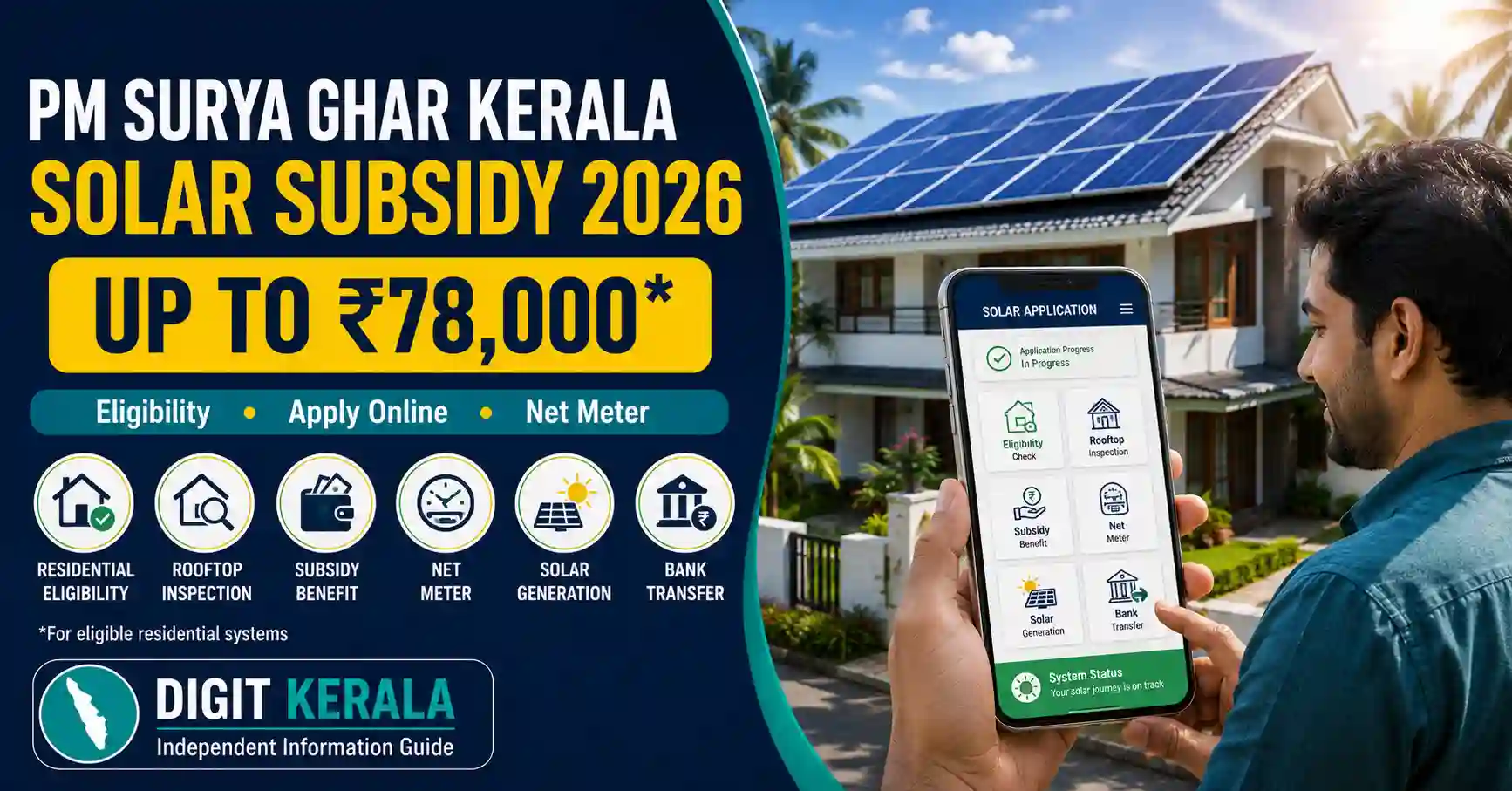
PM Surya Ghar: Muft Bijli Yojana is a Central Government rooftop-solar scheme designed to help eligible residential households install grid-connected solar-power systems.
Kerala households with a valid residential electricity connection and a suitable rooftop can apply through the official PM Surya Ghar National Portal. The scheme provides Central Financial Assistance, commonly described as a rooftop-solar subsidy, based on the approved system capacity.
For eligible residential installations, the subsidy can be ₹30,000 for a 1 kW system, ₹60,000 for a 2 kW system and up to ₹78,000 for a system of 3 kW or more under the current subsidy structure.
This guide explains PM Surya Ghar Yojana Kerala eligibility, subsidy amounts, online registration, vendor selection, KSEB feasibility approval, net-meter installation and subsidy-credit procedure.
Important: The scheme does not provide an unconditional cash payment or 300 electricity units directly to every applicant. The household must install and commission an eligible rooftop-solar system. Electricity-bill savings depend on solar generation, household consumption, weather, system performance and applicable electricity regulations.
What Is PM Surya Ghar Muft Bijli Yojana?
PM Surya Ghar: Muft Bijli Yojana was launched to promote residential rooftop-solar installations across India.
Eligible households can receive financial support for installing a grid-connected rooftop-solar plant. Electricity generated by the system can be used by the household, helping reduce the amount of electricity purchased from the distribution company.
When the installation is connected through an approved net meter, surplus electricity may be exported to the grid according to the applicable regulations.
The main benefits may include:
- Central subsidy for an eligible rooftop-solar system.
- Reduced dependence on grid electricity.
- Possible reduction in electricity bills.
- Net-metering facility subject to technical approval.
- Access to registered solar vendors.
- Financing options displayed through the official portal.
- Online application and status tracking.
- Direct subsidy transfer after successful commissioning and verification.
Submitting an application does not guarantee technical approval, loan approval, installation or subsidy payment.
PM Surya Ghar Subsidy Amount in 2026
The Central Financial Assistance for eligible residential consumers is calculated according to the approved rooftop-solar capacity.
| Rooftop-solar capacity | Current subsidy support |
|---|---|
| 1 kW | ₹30,000 |
| 2 kW | ₹60,000 |
| 3 kW | ₹78,000 |
| More than 3 kW | Maximum subsidy generally capped at ₹78,000 |
The subsidy structure provides ₹30,000 per kW for the first 2 kW and ₹18,000 for the additional 1 kW.
A household installing a system larger than 3 kW may still receive a maximum Central subsidy of ₹78,000 under the standard residential category.
The final eligible amount depends on:
- Approved plant capacity.
- Applicable scheme guidelines.
- Successful installation.
- Use of an eligible registered vendor.
- Technical inspection and commissioning.
- Submission of correct bank and beneficiary information.
- Compliance with current MNRE and DISCOM requirements.
Check the amount displayed on the official portal before placing an order or making payment to a vendor.
Does the Scheme Give 300 Units of Free Electricity?
The expression “up to 300 units of free electricity” refers to the potential electricity generated by a suitably sized rooftop-solar system and the resulting savings.
It should not be understood as an automatic monthly credit of 300 free KSEB units for every registered applicant.
The actual solar generation can vary because of:
- Solar-system capacity.
- Available shade-free rooftop area.
- Direction and angle of the panels.
- Weather and seasonal conditions.
- Trees or buildings creating shade.
- Panel quality and maintenance.
- Inverter efficiency.
- Household electricity consumption.
A household may still receive an electricity bill for grid consumption, fixed charges, meter-related charges or other applicable items.
Ask the registered vendor for a written generation estimate based on the specific rooftop before selecting the system capacity.
Who Can Apply in Kerala?
According to the official scheme information, an applicant should generally meet the following conditions:
- The applicant must be an Indian citizen.
- The household must have a valid residential electricity connection.
- The applicant should own a house with a suitable rooftop.
- The rooftop should have sufficient space and sunlight for installing solar panels.
- The household should not have already received another subsidy for the same rooftop-solar installation.
- The installation must comply with current scheme and electricity-distribution requirements.
The subsidy is primarily intended for the residential sector.
Commercial shops, offices, factories and other non-residential connections should not assume that they qualify for the residential subsidy. Such consumers should check the applicable renewable-energy and net-metering rules separately.
Tenants, residents of apartments and people whose electricity connection is in another person’s name should obtain clarification through the official portal or KSEB before making any payment.
Who May Not Be Eligible?
An application may be ineligible or require additional clarification in situations such as:
- The electricity connection is not residential.
- The applicant does not have authority to use the rooftop.
- The rooftop is structurally or technically unsuitable.
- Another subsidy was already received for the same installation.
- The system was installed without completing the required portal procedure.
- The vendor is not registered for the scheme.
- The proposed capacity exceeds the technically permitted capacity.
- Application and electricity-connection information do not match.
- The installation does not meet approved technical specifications.
- Required inspection or commissioning has not been completed.
Eligibility must be confirmed before purchasing equipment.
Documents and Information That May Be Required
Applicants should keep the following information ready:
- Residential electricity consumer number.
- Applicant’s mobile number.
- Email address.
- Latest electricity bill.
- Applicant’s identity information.
- Address information.
- Rooftop-ownership or occupancy details when requested.
- Rooftop photographs when requested.
- Bank-account details.
- Bank passbook or cancelled cheque.
- Vendor quotation and installation information.
- Technical-feasibility approval.
- Net-meter and commissioning documents.
The exact documents may change according to the portal workflow, KSEB verification and the applicant’s circumstances.
Upload clear and readable documents. The name, consumer number and bank details should be checked carefully before submission.
Official Website for Online Application
Applications should be submitted only through the official National Portal:
The official portal is administered under the Ministry of New and Renewable Energy.
Avoid advertisements or private websites using similar names. A private solar company’s website is not the official government application portal.
Do not share passwords, OTPs, bank verification codes or full identity documents with unknown agents.
How to Apply for PM Surya Ghar Yojana in Kerala
Follow these general steps.
Step 1: Open the Official Portal
Visit the official PM Surya Ghar portal.
Select the consumer-registration or rooftop-solar application option.
Step 2: Select Kerala and the Electricity Distribution Company
Select:
- State: Kerala.
- Electricity Distribution Company: the company shown for the applicant’s connection, normally KSEB for eligible KSEB consumers.
Enter the electricity consumer number exactly as shown on the bill.
Step 3: Complete Consumer Registration
Provide the requested:
- Consumer number.
- Mobile number.
- Email address.
- Verification information.
Complete the OTP or other verification displayed by the portal.
Step 4: Submit the Rooftop-Solar Application
Sign in using the registered consumer details and complete the rooftop-solar application.
Enter the proposed system capacity and other required information.
The capacity should be selected after considering:
- Average monthly electricity consumption.
- Available rooftop area.
- Sanctioned electrical load.
- Technical feasibility.
- Expected solar generation.
- Applicant’s budget.
Do not select a larger plant solely to claim a higher subsidy.
Step 5: Wait for Technical-Feasibility Approval
The electricity-distribution company must review whether the proposed rooftop-solar installation can be connected to the grid.
Do not start the installation before receiving the required feasibility approval unless the official portal specifically instructs otherwise.
Technical approval can depend on the connection, transformer capacity, proposed system size and applicable electricity regulations.
Step 6: Select a Registered Vendor
After feasibility approval, select a vendor registered on the official portal.
Compare:
- Total quoted price.
- Solar-panel manufacturer and model.
- Inverter make and warranty.
- Structure and installation materials.
- Panel and inverter capacity.
- Workmanship warranty.
- Maintenance support.
- Expected generation.
- Net-meter-related expenses.
- Additional structural or wiring costs.
- Payment schedule.
- After-sales service.
Obtain a complete written quotation and invoice.
A low quotation should not be selected without checking equipment quality, warranty and portal registration.
Step 7: Complete the Installation
The selected vendor installs the rooftop-solar system according to the approved capacity and technical standards.
The applicant should confirm that the installed panel, inverter and other system details match the quotation and portal application.
Keep copies of:
- Vendor agreement.
- Payment receipts.
- Tax invoice.
- Equipment serial numbers.
- Warranty documents.
- Installation photographs.
- Technical documents.
Step 8: Submit Installation Details
After installation, the plant information must be updated on the official portal.
The vendor or applicant may need to provide:
- Installed capacity.
- Panel and inverter details.
- Installation photographs.
- Technical certificates.
- Invoice information.
- Other documents requested by the portal.
Review all information before submission.
Step 9: Apply for Net Meter
Submit the net-meter request through the applicable portal procedure.
A net meter records electricity imported from the grid and electricity exported from the rooftop-solar system.
The meter and grid connection must be installed or approved according to KSEB and Kerala electricity regulations.
Additional meter, cable, structure or electrical-work expenses may apply. Confirm these costs in writing.
Step 10: Inspection and Commissioning
The distribution company may inspect the installation.
The inspection may verify:
- Approved system capacity.
- Safety arrangements.
- Metering requirements.
- Inverter specifications.
- Electrical protection.
- Grid-connectivity compliance.
- Installed equipment.
- Application information.
After successful inspection and net-meter installation, a commissioning certificate or report is generated through the official process.
Step 11: Submit Bank Details for Subsidy
After commissioning, enter the requested bank-account information through the official portal.
The applicant may be required to upload a cancelled cheque or another bank document.
Ensure that:
- Account number is correct.
- IFSC code is correct.
- Account holder information is accurate.
- The account is active.
- The uploaded document is clear.
Incorrect bank details can delay or prevent subsidy credit.
Step 12: Track the Subsidy Status
Use the official portal login to track:
- Registration.
- Feasibility approval.
- Vendor selection.
- Installation.
- Net-meter request.
- Inspection.
- Commissioning.
- Subsidy redemption.
- Bank-credit status.
Do not submit duplicate applications unless instructed by the responsible authority.
How Is the Subsidy Paid?
The rooftop-solar subsidy is generally transferred to the eligible beneficiary’s bank account after:
- Registration and application.
- Technical-feasibility approval.
- Installation through the approved process.
- Net-meter installation.
- Inspection and commissioning.
- Submission of correct bank details.
- Final portal verification.
The subsidy is not normally paid in advance for purchasing panels.
An official 2025 update reported an average Central Financial Assistance processing time of around 15 days after the redemption request when portal information is correct. This should not be treated as a guaranteed deadline.
Processing can take longer because of verification, incorrect bank information, missing documents or technical issues.
How Much Will the Applicant Have to Pay?
The subsidy does not necessarily cover the full cost of a rooftop-solar system.
The applicant may need to pay:
- Remaining system cost after subsidy.
- Additional mounting-structure cost.
- Roof-strengthening work.
- Extra cable requirements.
- Electrical-panel modifications.
- Earthing and safety equipment.
- Net-meter-related charges.
- Maintenance expenses.
- Loan interest when financing is used.
- Other costs not included in the vendor’s base quotation.
Prices vary depending on the system capacity, equipment brand, roof type and vendor.
Always obtain an itemised quotation showing:
- Total project price.
- Expected subsidy.
- Applicant contribution.
- Taxes.
- Equipment details.
- Additional charges.
- Warranty coverage.
- Payment milestones.
Do not depend only on verbal promises.
Can Applicants Take a Solar Loan?
Financing options may be available for eligible residential rooftop-solar systems.
Loan approval is separate from scheme registration and depends on:
- Bank eligibility rules.
- Applicant’s income and repayment capacity.
- Credit assessment.
- Required documents.
- Proposed system cost.
- Current interest rate.
- Other lender conditions.
The interest rate and EMI may change. Check the latest terms directly with the participating bank before accepting a loan.
Registration under PM Surya Ghar does not guarantee loan approval.
How to Select the Correct Solar Capacity
The appropriate capacity depends on the household’s electricity use and rooftop conditions.
The official guidance broadly indicates:
| Average monthly consumption | Suggested system range |
|---|---|
| 0–150 units | 1–2 kW |
| 150–300 units | 2–3 kW |
| More than 300 units | More than 3 kW may be considered |
This is general guidance, not an individual engineering recommendation.
Before deciding, check:
- Electricity consumption for the previous 12 months.
- Daytime electricity usage.
- Shade-free roof area.
- Roof condition.
- Available sanctioned load.
- Technical-feasibility limits.
- Vendor generation estimate.
- Total cost after subsidy.
- Expected maintenance.
A larger system does not automatically mean a zero electricity bill.
Important Questions to Ask the Vendor
Before making payment, ask:
- Are you currently registered on the official PM Surya Ghar portal?
- What is the exact approved system capacity?
- Which panel and inverter models will be installed?
- Are the modules eligible under the current scheme requirements?
- What is included in the quoted amount?
- Is the structure suitable for the applicant’s roof?
- What expenses are excluded?
- Who will submit the installation details?
- Who is responsible for the net-meter application?
- What warranties apply?
- Is there an annual-maintenance charge?
- What is the expected yearly generation?
- What happens if the portal rejects any equipment information?
- Will a proper invoice and payment receipt be provided?
Verify the vendor’s current status through the official portal.
Common Reasons for Application Delays
An application can be delayed because of:
- Incorrect consumer number.
- Mobile-number verification issue.
- Name mismatch.
- Incomplete application.
- Technical-feasibility review.
- Transformer-capacity limitation.
- Unregistered vendor.
- Incorrect equipment details.
- Incomplete installation documents.
- Pending net-meter installation.
- Inspection delay.
- Incorrect bank account or IFSC.
- Unclear cancelled-cheque image.
- Duplicate application.
- Portal or payment issue.
Check the portal dashboard regularly and respond only to verified communications.
Electricity Bill After Solar Installation
Installing rooftop solar does not always eliminate the entire electricity bill.
A bill may still include:
- Electricity imported from the grid.
- Fixed charges.
- Meter charges.
- Duties or taxes.
- Minimum charges.
- Previous balance.
- Other charges permitted under current regulations.
Solar generation may also reduce during cloudy or rainy periods.
Review the post-installation KSEB bill and compare the import, export and net-energy readings.
If the readings appear incorrect, contact KSEB through its official customer-service channel.
Safety Precautions
A rooftop-solar plant is an electrical installation and should be handled only by qualified professionals.
Applicants should ensure:
- Proper earthing.
- Approved electrical protection.
- Safe cable routing.
- Strong mounting structure.
- Weather-resistant installation.
- Fire and electrical safety.
- Safe access for maintenance.
- Protection from water leakage.
- Compliance with grid standards.
Do not climb onto a wet or unsafe rooftop to inspect panels.
Do not attempt to repair an inverter, panel cable or grid connection without an authorised technician.
Fraud-Prevention Tips
Follow these precautions:
- Use only the official PM Surya Ghar portal.
- Verify vendors through the portal.
- Do not pay anyone promising guaranteed subsidy.
- Do not share OTPs or online-banking passwords.
- Obtain invoices for every payment.
- Avoid cash payments without receipts.
- Read the complete quotation.
- Confirm equipment and warranty details.
- Do not install before the required feasibility approval.
- Never submit false rooftop or electricity information.
- Check bank details before requesting the subsidy.
- Keep portal acknowledgements and commissioning documents.
No private agent can guarantee technical approval, subsidy credit or a zero electricity bill.
Frequently Asked Questions
Can Kerala residents apply for PM Surya Ghar Yojana?
Eligible Kerala households with a valid residential electricity connection and a suitable rooftop can apply through the official National Portal.
What is the maximum subsidy?
Under the current standard subsidy structure, eligible residential installations of 3 kW or more may receive a maximum Central subsidy of ₹78,000.
Is ₹78,000 available for a 1 kW plant?
No. The current subsidy is ₹30,000 for 1 kW, ₹60,000 for 2 kW and ₹78,000 for 3 kW or higher, subject to eligibility and successful commissioning.
Will every applicant receive 300 free electricity units?
No. The phrase refers to potential generation and savings from an appropriately sized rooftop-solar system. Actual generation and electricity bills vary.
Can a commercial shop apply for the residential subsidy?
The household subsidy is intended for eligible residential connections. Commercial consumers should check the separately applicable rules.
Can the system be installed before applying?
Applicants should first register, submit the application and obtain the required feasibility approval. Installing before completing the approved procedure can affect subsidy eligibility.
Can any solar company install the system?
For scheme benefits, use a vendor currently registered through the official portal and follow the approved application procedure.
Is the subsidy paid before installation?
The subsidy is generally credited only after installation, net-metering, inspection, commissioning and final verification.
Is a solar loan guaranteed?
No. Loan approval depends on the participating bank’s current eligibility and credit rules.
Does rooftop solar guarantee a zero KSEB bill?
No. The final bill depends on generation, consumption, imports, exports and applicable fixed or other charges.
Official References
- PM Surya Ghar National Portal
- Consumer Registration Portal
- Ministry of New and Renewable Energy
- Official Eligibility, Subsidy and Application Steps
- Official PM Surya Ghar Scheme Update
- Kerala State Electricity Board
Last reviewed: August 27, 2026.
Disclaimer: DIGIT KERALA is an independent information website and is not affiliated with the Ministry of New and Renewable Energy, PM Surya Ghar Portal, KSEB or any government organisation. This article provides general information only. Eligibility, subsidy amounts, technical requirements, electricity regulations, vendor availability and portal procedures may change. Registration does not guarantee feasibility approval, loan approval, installation, subsidy payment or a zero electricity bill. Always verify the latest information through the official portal before making a payment or financial decision.