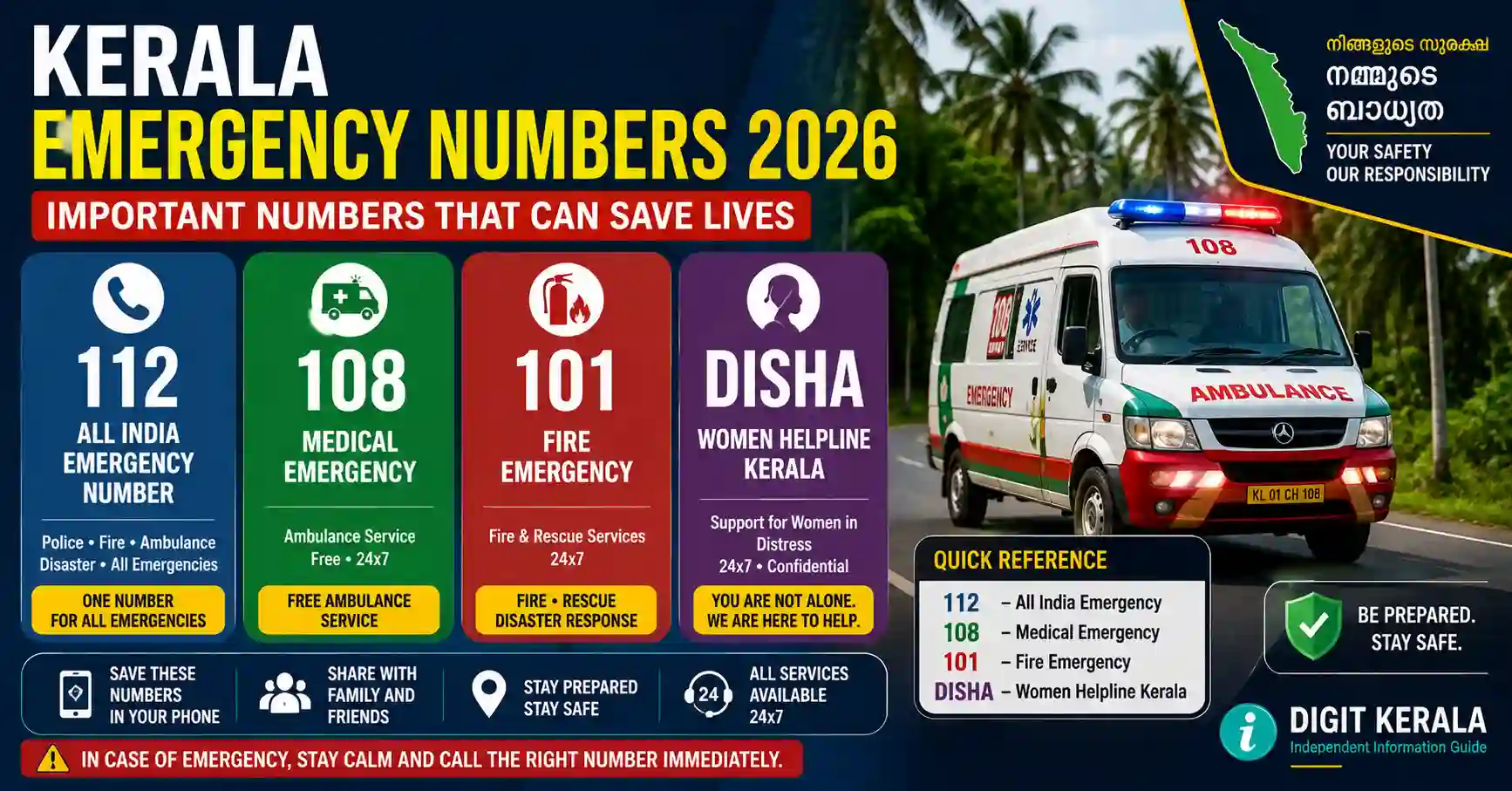
Knowing the correct Kerala emergency helpline numbers can save valuable time during an accident, medical emergency, fire, gas leak or another dangerous situation.
People do not always need to remember several different numbers. The Emergency Response Support System provides 112 as an integrated emergency number. Kerala also continues to provide dedicated services such as KANIV-108 Ambulance, Fire and Rescue 101 and the DISHA 1056 health helpline.
This guide explains which number to call, what information to provide and how to avoid common mistakes during an emergency.
Emergency warning: If a person is in immediate danger, call 112 or the relevant emergency service without waiting to finish reading an online article.
Kerala Emergency Numbers: Quick Reference
| Emergency or Service | Number | When to Use |
|---|---|---|
| Integrated Emergency Response | 112 | Police, fire, rescue, health emergency or immediate danger |
| KANIV Emergency Ambulance | 108 | Serious medical emergency or emergency ambulance assistance |
| Kerala Fire and Rescue | 101 | Fire, trapped persons and eligible rescue emergencies |
| DISHA Health Helpline | 1056 | Health information, counselling and guidance |
| DISHA Alternative Number | 104 | Kerala health guidance and support |
| DISHA Landline | 0471-2552056 | Alternative access to the DISHA health helpline |
| LPG Leak Emergency | 1906 | Emergency involving a domestic LPG leak |
Save the important numbers on the phone, but also write them in a visible place at home.
Helpline availability, integration and response can depend on the location, mobile network and nature of the emergency. When unsure which emergency service is required, call 112.
Call 112 for an Immediate Emergency
The Emergency Response Support System, known as ERSS, provides 112 as an integrated emergency number.
According to Kerala Police, a citizen can call 112 to seek emergency support. The service is designed to coordinate an appropriate response through the state emergency system.
Call 112 for situations such as:
- Immediate danger to life.
- Road accident requiring emergency assistance.
- Violence or a serious threat.
- Burglary or another crime in progress.
- Fire or major rescue requirement.
- A person trapped in a dangerous location.
- Serious medical emergency when the correct number is uncertain.
- Another situation requiring urgent police, fire, rescue or health support.
Do not use 112 for routine enquiries, document applications, non-urgent complaints or checking general information.
What Happens After Calling 112?
Calls are received through the emergency response system and can be sent to the appropriate response unit according to the reported situation.
The caller may be asked for:
- Type of emergency.
- Exact location.
- Nearby landmark.
- Caller’s name and mobile number.
- Number of people affected.
- Whether anyone is injured or trapped.
- Description of the immediate danger.
- Vehicle details in a road accident.
- Information about a suspect when police support is required.
- Whether fire, smoke, gas or another hazard is present.
Answer clearly and remain on the call until the operator says it can be ended.
Do not exaggerate or hide important information. Correct information helps the emergency service determine what assistance may be required.
Call 108 for an Emergency Ambulance
Kerala’s KANIV emergency ambulance service can be contacted by dialling 108.
The official Kerala Health Portal describes 108 Ambulance as an emergency medical service operating across Kerala.
Call 108 when emergency ambulance assistance may be required, including situations such as:
- Serious road-accident injury.
- Unconscious person.
- Severe breathing difficulty.
- Suspected heart attack.
- Suspected stroke.
- Heavy or uncontrolled bleeding.
- Serious burns.
- Severe allergic reaction.
- Poisoning or suspected poisoning.
- Serious fall or head injury.
- Pregnancy-related emergency.
- Seizure that continues, repeats or creates immediate danger.
- Snakebite or another potentially dangerous bite.
- Any rapidly worsening condition that may threaten life.
This list is not a diagnosis guide. If the situation appears life-threatening or the caller is uncertain, contact 108 or 112 and follow the operator’s instructions.
Information to Give the Ambulance Operator
When requesting an ambulance, provide:
- Exact location of the patient.
- District, town and local area.
- A nearby landmark.
- Patient’s approximate age when known.
- What happened.
- Whether the patient is conscious.
- Whether the patient is breathing.
- Number of injured or ill people.
- Known immediate hazards.
- Caller’s active mobile number.
Send someone to a visible location to guide the ambulance when this can be done safely.
Keep the access road, gate, staircase or lift area clear. Gather the patient’s available medical records, current medicine list and identification without delaying emergency care.
Do Not Delay an Ambulance Call
Do not postpone an emergency call while:
- Searching for home remedies.
- Waiting for symptoms to disappear.
- Posting the incident on social media.
- Taking unnecessary photographs or videos.
- Calling several relatives before requesting assistance.
- Trying to identify the exact medical condition online.
- Waiting for an unverified private service to respond.
An emergency operator or qualified healthcare professional should guide the next steps.
Online information cannot examine the patient or determine the severity of the condition.
Call 101 for Fire and Rescue
The official Kerala Fire and Rescue Services website lists 101 for emergencies.
Call 101 for situations such as:
- Building or vehicle fire.
- Person trapped inside a building.
- Smoke coming from an unknown source.
- Electrical fire.
- Industrial or commercial fire.
- Eligible water rescue.
- Person trapped in a lift, well or dangerous structure.
- Collapsed structure.
- Another situation requiring trained fire or rescue personnel.
The integrated number 112 can also be used when the caller is unsure which service should respond.
What to Do When Reporting a Fire
Tell the operator:
- Exact address.
- Name of the building or establishment.
- Floor or area affected.
- Type of building.
- Whether people are trapped.
- Whether gas cylinders, fuel or chemicals may be present.
- Safe entry route when known.
- Caller’s mobile number.
Move to a safe location before making the call when there is immediate danger.
Do not remain inside a burning or smoke-filled building to collect valuables. Do not re-enter the building until the responsible emergency personnel confirm that it is safe.
Follow the instructions given by Fire and Rescue personnel.
Basic Fire-Evacuation Safety
During a fire:
- Alert people nearby.
- Leave by the safest available exit.
- Use stairs instead of a lift.
- Stay away from smoke when possible.
- Help children, older adults and persons with disabilities without placing additional lives in danger.
- Close doors behind you when this can be done safely.
- Move to the designated assembly area.
- Call 101 or 112 from a safe location.
- Tell responders if someone may still be inside.
- Do not block the access road used by emergency vehicles.
Fire extinguishers should be used only by someone who understands their operation, has a safe exit and is dealing with a small, manageable fire. Evacuation and calling emergency services should not be delayed.
DISHA 1056 Kerala Health Helpline
DISHA stands for Direct Intervention System for Health Awareness.
According to the official Kerala Health DISHA page, it is a statewide health helpline operated as a joint initiative of the National Health Mission and the Kerala Department of Health.
The service is accessible through:
- 1056 — toll-free DISHA number.
- 104 — additional Kerala health-helpline number.
- 0471-2552056 — DISHA landline number.
The official portal describes DISHA as a 24-hour service.
DISHA may provide eligible assistance with:
- General health information.
- First-aid and disease-prevention guidance.
- Information about hospitals and health services.
- Nutrition and lifestyle guidance.
- Mental-health support.
- Stress and anxiety counselling.
- Information about government health programmes.
- Guidance on when further medical attention may be required.
- Support and information during public-health alerts.
The exact service provided depends on the caller’s situation and current programme arrangements.
DISHA Is Not a Replacement for an Ambulance
DISHA provides health information and professional guidance. It should not be used to delay emergency assistance.
Call 108 or 112 instead of waiting for general health guidance when a person has:
- Severe difficulty breathing.
- Unconsciousness.
- Heavy bleeding.
- Serious accident injuries.
- Suspected stroke or heart attack.
- Serious burns.
- Severe allergic reaction.
- Poisoning.
- Another potentially life-threatening condition.
When uncertain, clearly tell the DISHA or emergency operator what is happening and follow the instructions provided.
Call 1906 for an LPG Leak Emergency
The Government of India’s National Portal lists 1906 as the central emergency number for LPG-leak complaints.
The service is intended for emergency leakage situations involving domestic LPG connections.
If LPG odour or a leak is suspected:
- Do not light a match, candle or flame.
- Extinguish existing flames when this can be done safely.
- Do not operate electrical switches.
- Do not use electrical or battery-operated equipment near the suspected leak.
- Turn off the cylinder regulator only when it can be done safely.
- Open doors and windows for ventilation when safe.
- Move people away from the immediate risk.
- Call 1906 from a safe location.
- Call 101 or 112 if there is a fire or immediate danger.
- Follow the instructions of the gas distributor and emergency personnel.
Do not attempt to repair a cylinder, regulator, valve or hose without an authorised technician.
Which Number Should You Call?
Call 112 When:
- The situation involves immediate danger.
- Police assistance is required.
- More than one emergency service may be needed.
- The caller is unsure which service to contact.
- Fire, rescue or medical assistance is urgently required.
Call 108 When:
- An emergency ambulance is specifically required.
- A person has serious injuries or a potentially life-threatening medical condition.
- Emergency transport and pre-hospital assistance may be necessary.
Call 101 When:
- A fire is reported.
- A person is trapped.
- A specialised fire or rescue response is required.
Call 1056 or 104 When:
- General health information is required.
- The caller needs eligible health or emotional-support guidance.
- Information about Kerala health services is needed.
- The situation is not an immediate life-threatening emergency.
Call 1906 When:
- A domestic LPG leak is suspected.
- Emergency assistance from the LPG service network is required.
If the situation changes or becomes immediately dangerous, call 112.
What to Say During an Emergency Call
A clear emergency call can follow this order:
- State the emergency: “There has been a road accident.”
- Give the exact location.
- Mention a nearby landmark.
- State how many people are affected.
- Describe immediate injuries or danger.
- Mention fire, fuel, electricity, water or another hazard.
- Give the caller’s name and number.
- Answer the operator’s questions.
- Repeat the location when requested.
- Remain available for a return call.
Use simple and direct language.
If the caller does not know the exact address, provide:
- Road name.
- Junction.
- Building name.
- Shop, school, hospital or place of worship nearby.
- Direction of travel.
- Vehicle registration number when relevant.
- Location pin when requested and safely available.
Do not end the call immediately after saying only “send help.”
If the Emergency Call Does Not Connect
If one number does not connect:
- Try 112.
- Move to a location with better network coverage when safe.
- Ask another person to call.
- Use a different available phone.
- Contact the nearest police station, fire station or hospital through an officially verified number.
- Send someone to seek help when communication is unavailable and it is safe to do so.
Do not repeatedly call several services after assistance has already been confirmed unless the condition or location changes.
Keep the phone available because the control room or response team may call back.
Road-Accident Safety
When witnessing a road accident:
- Stop only in a safe location.
- Turn on hazard lights when appropriate.
- Avoid standing in moving traffic.
- Warn approaching vehicles without creating another hazard.
- Call 112 or 108.
- Give the exact road and direction.
- Mention the number of injured people.
- Do not crowd around the injured person.
- Do not give food, drink or medicine unless instructed by a qualified professional.
- Do not move a seriously injured person unless there is immediate danger or emergency personnel instruct it.
- Follow instructions given by the emergency operator.
- Keep space available for the ambulance and rescue vehicles.
Do not record or publicly share identifiable images of injured people.
Protect their privacy and dignity.
Medical-Emergency Preparation at Home
Every household can prepare a simple emergency-information sheet containing:
- Home address.
- Nearby landmark.
- 112 emergency number.
- 108 ambulance number.
- 101 fire number.
- DISHA 1056.
- LPG emergency number 1906.
- Contact details of close family members.
- Regular doctor’s number.
- Known allergies.
- Current medicines.
- Important medical conditions.
- Blood group, when verified.
Keep the information somewhere easily accessible while protecting sensitive personal data.
Older adults, children and regular caregivers should know where the emergency list is kept.
Emergency Information on a Mobile Phone
A phone may provide features for storing:
- Emergency contacts.
- Medical information.
- Allergies.
- Blood group.
- Emergency SOS settings.
- Lock-screen emergency details.
Feature availability and activation methods vary by Android phone and iPhone model.
Review the device manufacturer’s official instructions. Test settings carefully without making a false emergency call.
Do not store unnecessary identity-document numbers or complete financial information on a visible lock screen.
Help Emergency Vehicles Reach the Location
After requesting assistance:
- Keep the caller’s phone switched on.
- Answer return calls.
- Unlock the gate when safe.
- Clear parked vehicles from the entrance.
- Switch on an outside light at night.
- Send someone to a nearby junction when safe.
- Keep pets away from the response path.
- Inform building security.
- Reserve the lift for responders when appropriate.
- Gather only essential patient information.
Do not allow crowds to block the ambulance, fire engine or police vehicle.
Avoid False and Prank Emergency Calls
Emergency numbers should be used responsibly.
A false or prank call can:
- Delay assistance to a genuine emergency.
- Waste limited emergency resources.
- Create unnecessary risk for response teams.
- Interfere with public-safety operations.
- Result in action under applicable law.
Children should be taught when to call an emergency number and what information to provide.
An accidental call should not simply be disconnected. Tell the operator that it was accidental and answer any confirmation questions.
Emergency Call Safety and Fraud Prevention
Official emergency responders may need the caller’s location and incident information.
However:
- Do not disclose bank passwords.
- Never share an ATM PIN.
- Do not provide a UPI PIN.
- Do not reveal an account password.
- Do not install a screen-sharing application on an unknown caller’s instruction.
- Do not make a payment to “activate” an emergency response.
- Do not trust a number solely because it was forwarded through social media.
- Verify non-emergency contact numbers through official government websites.
Emergency helplines do not require political support, membership or payment to accept a genuine emergency report.
Common Mistakes to Avoid
Avoid the following during an emergency:
- Giving an incomplete location.
- Disconnecting before the operator finishes.
- Moving an injured person unnecessarily.
- Gathering around the patient.
- Blocking emergency vehicles.
- Spreading unverified information.
- Filming victims.
- Calling a health-information line instead of an ambulance during a life-threatening situation.
- Trying to fight a large fire without training.
- Operating electrical switches during a suspected LPG leak.
- Delaying the emergency call while searching online.
The safest action depends on the situation. Follow the instructions of the emergency operator and authorised responders.
Frequently Asked Questions
What is Kerala’s main emergency number?
Kerala Police lists 112 as the Emergency Response Support System number. It can be used to request urgent emergency support.
Which number should be called for an ambulance in Kerala?
Call 108 for the KANIV emergency ambulance service. When the correct service is uncertain, call 112.
What is the Kerala Fire and Rescue number?
The official Kerala Fire and Rescue Services website lists 101 for emergencies.
What is DISHA 1056?
DISHA is Kerala’s health-information and counselling helpline. It can be reached through 1056, and official Kerala Health pages also list 104 and 0471-2552056.
Can DISHA send an emergency ambulance?
DISHA provides health guidance and information. For an immediate life-threatening emergency or emergency ambulance, call 108 or 112.
What is the LPG leak emergency number?
The central LPG leak emergency number is 1906.
Should I call 112 or 101 for a fire?
Calling 101 directly contacts the fire-emergency service. The integrated 112 number can also be used when several services may be required or the caller is uncertain.
What information should I give an emergency operator?
Provide the type of emergency, exact location, nearby landmark, number of affected people, immediate hazards and an active callback number.
Should an accident victim be given water?
Do not give food, drink or medicine unless instructed by a qualified healthcare professional or emergency operator.
Are emergency-response times guaranteed?
No. Response time can depend on the location, road conditions, availability, incident details and other operational factors. Give accurate location information and follow the operator’s instructions.
Official References
- Kerala Police Emergency Response Support System
- Kerala Police Official Website
- Kerala Health Portal
- Kerala Health DISHA 1056
- Kerala Fire and Rescue Services
- Government of India Helpline Directory
- LPG Emergency Leakage Service
- Ministry of Home Affairs ERSS Information
Last reviewed: August 30, 2026.
Disclaimer: DIGIT KERALA is an independent information website and is not affiliated with Kerala Police, Kerala Health Department, National Health Mission, KANIV-108, Kerala Fire and Rescue Services, ERSS, any LPG company or government organisation. This article provides general emergency-preparedness information and is not a substitute for professional medical, police, fire or rescue assistance. Helpline operations and service arrangements may change. In an immediate emergency, contact 112 or the appropriate official emergency service and follow the instructions provided.