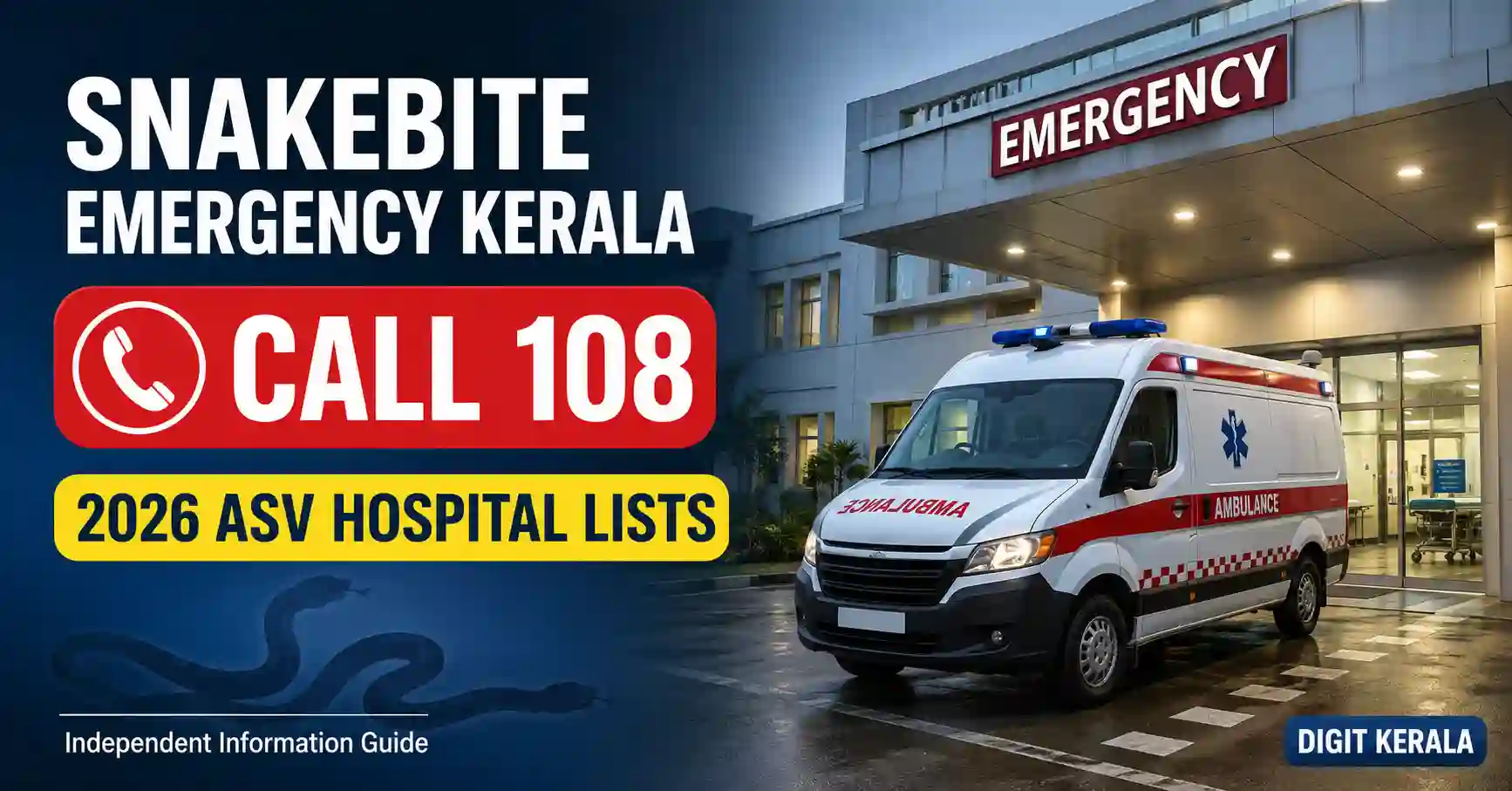
Snakebite Treatment Hospitals in Kerala are available across government and private healthcare facilities. However, a snakebite is a time-sensitive medical emergency, and people should not spend valuable time searching through an old hospital list or travelling from one hospital to another.
According to the Kerala Health Department, people should call the KANIV-108 emergency ambulance service immediately after a suspected snakebite. The 108 team can provide first-aid guidance, confirm the availability of Anti-Snake Venom at the receiving hospital, alert the hospital in advance and arrange appropriate transportation.
Emergency information verified on August 26, 2026: Hospital facilities, contact details and Anti-Snake Venom availability may change. Always call 108 and follow the instructions provided by trained emergency personnel.
What to Do Immediately After a Snakebite
If a person is bitten or possibly bitten by a snake, take the following steps without delay:
- Call the KANIV emergency ambulance service by dialling 108.
- Keep the person calm and reassure them.
- Reduce unnecessary movement as much as possible.
- Do not allow the person to walk or run.
- Immobilise the bitten limb using a simple splint or another suitable rigid support.
- Remove rings, watches, bangles, footwear or other tight objects before swelling increases.
- Arrange immediate transportation to an appropriate healthcare facility.
- Follow the instructions given by the 108 emergency team until the ambulance arrives.
The Kerala Health Department advises people not to waste time independently searching for a hospital that stocks Anti-Snake Venom. The KANIV-108 team has access to information about treatment facilities and can coordinate with the receiving hospital.
Actions to Avoid After a Snakebite
Incorrect first-aid practices can delay proper treatment and may cause additional injury. Do not:
- Apply a tight tourniquet, rope or tight bandage around the limb.
- Cut, puncture or burn the bite area.
- Attempt to suck venom from the wound.
- Apply ice, herbs, oils, chemicals, stones or traditional medicines.
- Give alcohol or stimulants to the patient.
- Make the person run or walk.
- Delay hospital treatment while looking for the snake.
- Attempt to catch or kill the snake and risk another bite.
- Depend only on home remedies, faith healing or unqualified treatment.
If the snake can be observed safely from a distance, its appearance may be noted. However, nobody should attempt to catch or handle it. Doctors assess the patient’s symptoms, clinical condition and laboratory results when deciding treatment.
Call 108 Instead of Searching for a Hospital
The Kerala Health Department states that Anti-Snake Venom is available in 146 hospitals in the state. It is stocked in some Community Health Centres and in hospitals from the taluk level onwards.
Before transporting a snakebite patient, the KANIV-108 team can check whether Anti-Snake Venom and the required treatment facilities are available at the receiving hospital. The hospital may also be informed about the patient before arrival.
Therefore, the safest procedure is:
- Call 108 immediately.
- Explain that the emergency involves a suspected snakebite.
- Provide the exact location and a nearby landmark.
- Describe the patient’s current condition.
- Follow the emergency team’s instructions.
- Do not change the destination hospital without informing the ambulance team.
Learn more from the official Kerala Health Department snakebite advisory.
Official ASV Hospital Lists for Kerala
The Directorate of Health Services has published separate 2026 lists of government and private hospitals providing Anti-Snake Venom in Kerala.
Use the following official links:
- Official list of government hospitals providing ASV
- Official list of private hospitals providing ASV
- Kerala Directorate of Health Services medical information page
These official lists include facilities across Thiruvananthapuram, Kollam, Pathanamthitta, Alappuzha, Kottayam, Idukki, Ernakulam, Thrissur, Palakkad, Malappuram, Kozhikode, Wayanad, Kannur and Kasaragod.
The lists should be used only as a reference. ASV stock, emergency services, specialist availability and referral arrangements can change. Call 108 before travelling whenever possible.
Why the Hospital List May Change
A hospital appearing in an official list does not necessarily mean that every type of snakebite complication can be managed there at all times.
Treatment requirements may vary depending on:
- The patient’s symptoms and clinical condition.
- Availability of Anti-Snake Venom.
- Availability of doctors and trained emergency staff.
- Laboratory and monitoring facilities.
- Ventilator, dialysis or intensive-care requirements.
- The need for referral to a higher-level hospital.
Some patients may initially be taken to a nearby facility for assessment and stabilisation and later transferred to a specialised centre. The emergency team and treating doctors should decide the appropriate hospital based on the patient’s condition.
Is Anti-Snake Venom Given for Every Snakebite?
Anti-Snake Venom is not automatically administered for every suspected snakebite. Some bites may be from non-venomous snakes, while some venomous snakebites may not inject a significant amount of venom.
Doctors decide whether ASV is required based on symptoms, clinical examination and laboratory findings. ASV can also cause serious reactions in some patients, which is why it must be administered only in a properly equipped healthcare facility under medical supervision.
Do not purchase or attempt to administer Anti-Snake Venom outside a hospital.
Possible Warning Signs After a Snakebite
Symptoms can vary depending on the snake species, the amount of venom, the location of the bite and the time taken to receive treatment. Possible warning signs may include:
- Increasing pain or swelling around the bite.
- Bleeding from the bite, gums or other areas.
- Drooping eyelids or blurred vision.
- Difficulty speaking, swallowing or breathing.
- Severe weakness, drowsiness or confusion.
- Vomiting, abdominal discomfort or excessive sweating.
- Dark-coloured urine or reduced urine output.
- Fainting, collapse or loss of consciousness.
Symptoms may not always appear immediately. A person should receive urgent medical assessment even if the bite initially appears minor or painless.
Information to Give the 108 Emergency Team
When calling 108, clearly provide:
- Your name and contact number.
- The exact location of the patient.
- A nearby landmark.
- The approximate time of the bite.
- The part of the body that was bitten.
- The patient’s age and current symptoms.
- Whether the patient is conscious and breathing normally.
- Details of any first aid already provided.
Keep the phone available in case the emergency team needs additional directions.
Transporting a Snakebite Patient Safely
The patient should not walk to the vehicle or hospital. Carry the person using a stretcher or other safe support whenever possible.
Keep the patient calm and minimise movement during transportation. Continue immobilising the bitten limb and follow the directions of emergency medical personnel.
A motorcycle or other transport method that requires the patient to sit unsupported should be avoided when a safer option is available. If an ambulance cannot reach the location immediately, ask the 108 team for transportation guidance.
How to Reduce Snakebite Risk
Snakebites can occur around homes, farms, plantations, construction sites and areas with thick vegetation. The following precautions may reduce risk:
- Use a torch when walking outdoors at night.
- Wear suitable shoes or boots in fields and overgrown areas.
- Avoid placing hands inside holes, piles of wood or thick vegetation.
- Keep grass and bushes around the house trimmed.
- Remove waste, unused materials and places where rodents may hide.
- Store firewood and construction materials away from living areas.
- Seal openings under doors and around walls.
- Use a bed and mosquito net rather than sleeping directly on the floor.
- Shake shoes, clothing and bedding before using them.
- Contact trained snake rescuers instead of attempting to handle a snake.
Frequently Asked Questions
Which number should I call after a snakebite in Kerala?
Call the KANIV emergency ambulance service immediately by dialling 108. The emergency team can provide instructions and coordinate transportation to an appropriate hospital.
Which are the main Snakebite Treatment Hospitals in Kerala?
The Kerala DHS publishes official government and private hospital lists covering all 14 districts. Since availability can change, use the official PDF lists and call 108 instead of depending on an old copied list.
Is Anti-Snake Venom available in every hospital?
The Kerala Health Department reports that ASV is available in 146 hospitals, including some Community Health Centres and hospitals from the taluk level onwards. However, availability at a specific facility should be confirmed before transportation.
Should a tourniquet be applied after a snakebite?
No. A tight tourniquet or bandage can cause serious tissue damage and other complications. Keep the person calm, immobilise the bitten limb and arrange rapid medical transportation.
Should the snake be caught for identification?
No one should risk another bite by attempting to catch or handle the snake. Treatment decisions are primarily based on the patient’s symptoms, examination and laboratory findings.
Can a snakebite be treated at home?
No. A suspected snakebite requires urgent assessment at a healthcare facility. Home remedies and traditional treatments can delay lifesaving medical care.
Official References
This article was prepared using information published by official Kerala government health sources:
- Kerala Health Department snakebite emergency guidance
- Kerala State Action Plan for Prevention and Control of Snakebite Envenoming
- Kerala DHS official ASV hospital lists
- Official KANIV-108 ambulance information
Medical Disclaimer
This article is provided for general public information and emergency awareness only. DIGIT KERALA is an independent information website and is not affiliated with the Kerala Health Department, the Directorate of Health Services, KANIV-108 or any hospital listed in the official documents.
This content is not a substitute for professional medical diagnosis or treatment. In the event of an actual or suspected snakebite, call 108 immediately and follow the instructions of qualified emergency and medical professionals.