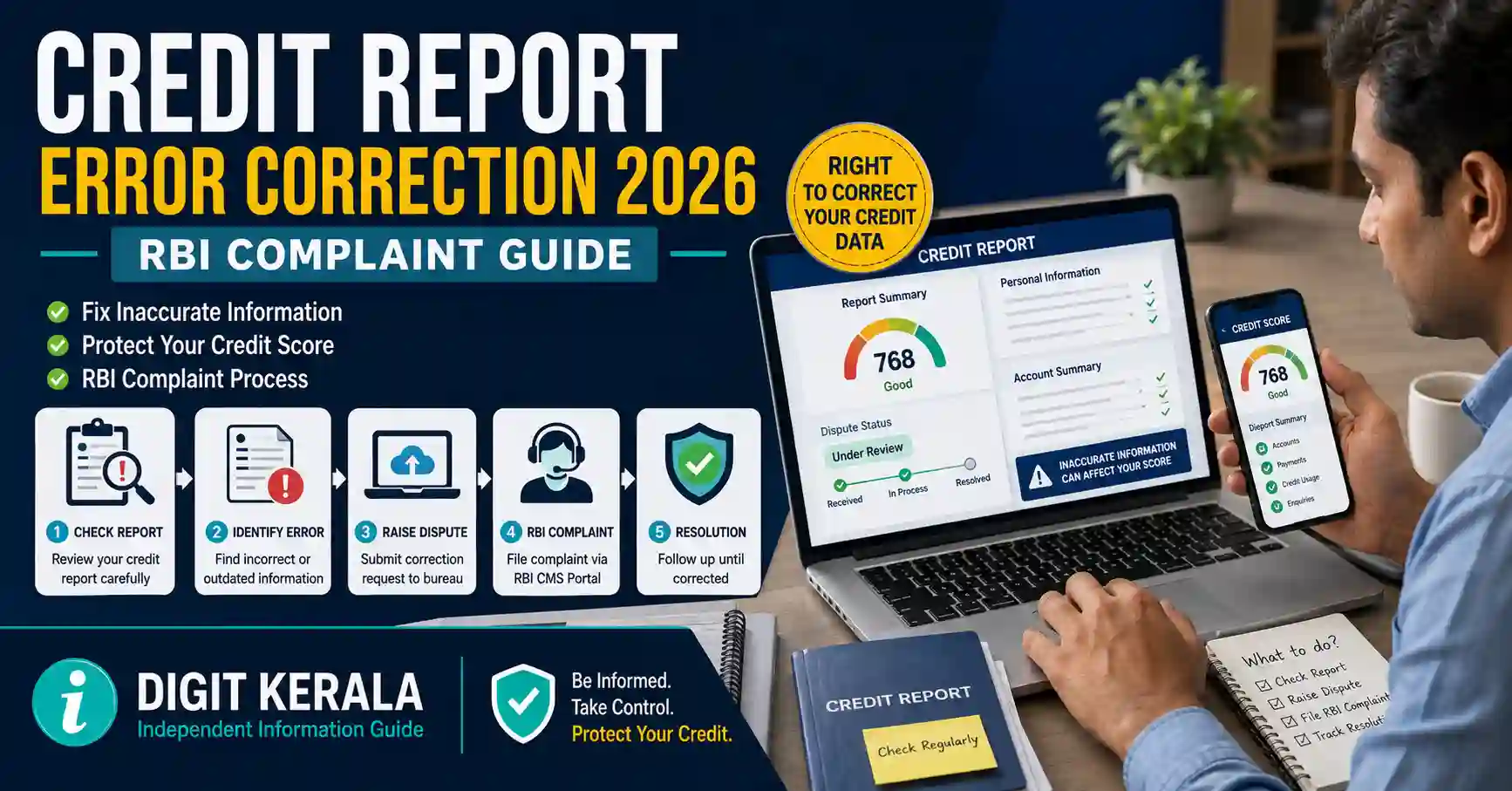
Incorrect information in a credit report can affect how banks and other lenders assess a loan or credit-card application.
Common problems include a closed loan appearing active, an incorrect overdue amount, an account belonging to another person or a repayment update that has not been properly reflected.
Customers can raise a dispute with the concerned Credit Information Company and the bank, NBFC or other lender that submitted the information.
RBI’s current framework provides an overall period of 30 calendar days for resolving eligible credit-information correction complaints. An eligible complainant may be entitled to compensation of ₹100 per calendar day when the complaint remains unresolved beyond this period.
Important: Compensation is not available merely because a customer disagrees with a credit score. The complaint must involve eligible delayed updation or rectification of credit information and satisfy the applicable RBI conditions.
What Is a Credit Report?
A credit report is a record of credit-related information maintained by a Credit Information Company.
It may contain information such as:
- Personal identification details.
- Loans reported by lenders.
- Credit-card accounts.
- Current and outstanding balances.
- Repayment history.
- Overdue information.
- Loan or card-account status.
- Credit enquiries.
- Settled, written-off or closed-account information.
- Credit score.
Banks, NBFCs and other eligible Credit Institutions submit customer credit information to registered Credit Information Companies.
A lender can use the report as one factor when assessing a credit application.
Credit Institution and Credit Information Company
Understanding these two terms can help when filing a dispute.
Credit Institution
A Credit Institution, or CI, is the organisation that provides or reports credit information.
It may include an eligible:
- Bank.
- NBFC.
- Credit-card issuer.
- Housing-finance provider.
- Co-operative credit institution.
- Another lender covered by the applicable credit-information framework.
The Credit Institution is normally responsible for verifying whether the information it supplied is accurate.
Credit Information Company
A Credit Information Company, or CIC, collects eligible information received from different Credit Institutions and prepares credit-information reports.
The CIC generally cannot independently remove an accurately reported loan or change a lender’s data merely because the customer requests it.
The CIC may send the dispute to the reporting lender for verification.
Common Credit Report Errors
Possible credit-report errors include:
- Loan account not belonging to the customer.
- Credit card not applied for by the customer.
- Closed loan still shown as active.
- Incorrect outstanding balance.
- Incorrect overdue amount.
- Paid instalment shown as unpaid.
- Duplicate loan account.
- Incorrect payment-history entry.
- Incorrect date of account opening.
- Wrong account-closure date.
- Incorrect personal information.
- Incorrect ownership category.
- Unrecognised credit enquiry.
- Repayment update not reflected.
- Account belonging to a person with a similar name.
- Written-off or settled status reported incorrectly.
A lower score by itself does not prove that the report contains an error.
Review the account-level information to identify a specific inaccurate entry.
One Free Full Credit Report Every Year
RBI requires Credit Information Companies to provide eligible individuals with access to one Free Full Credit Report, including the credit score, once during a calendar year.
The report is provided after the requester completes the CIC’s authentication process.
Use only a Credit Information Company’s official website.
The free-report link should be displayed prominently on the CIC’s website.
Do not enter PAN, Aadhaar or banking information on an unofficial “free credit score” website without checking how the information will be used.
What Should Be Checked in a Credit Report?
Review the following sections carefully.
Personal Information
Check:
- Full name.
- Date of birth.
- PAN.
- Address.
- Telephone number.
- Email information.
An old address is not always an error if it was previously reported by a lender. However, information belonging to another person should be disputed.
Account Information
Check:
- Lender’s name.
- Account type.
- Account-opening date.
- Credit limit or sanctioned amount.
- Outstanding balance.
- Overdue amount.
- Repayment history.
- Current account status.
- Closure date.
- Written-off or settlement status.
Credit Enquiries
Check whether the credit enquiries correspond to applications or requests made by the customer.
An unfamiliar enquiry should be reported to the concerned institution and CIC for verification.
Closed, Settled and Written-Off Are Different
These terms should not be treated as interchangeable.
Closed
A closed account generally indicates that the loan or credit facility was completed and closed according to the lender’s applicable records.
Settled
A settled account may indicate that the lender accepted an amount lower than the total amount originally payable.
A genuine settlement entry cannot automatically be changed to “closed” merely by submitting an online dispute.
Written-Off
A written-off status can indicate accounting treatment applied by the lender to an unpaid or partly unpaid debt.
Payment or later settlement does not necessarily erase the historical status automatically.
The reporting lender must determine the correct status according to the actual account records and applicable reporting rules.
Obtain Supporting Documents
Before raising a dispute, collect documents supporting the requested correction.
These may include:
- Loan-closure letter.
- No-dues certificate.
- Final loan statement.
- Payment receipts.
- Bank statement.
- Credit-card closure confirmation.
- Email from the lender.
- Settlement letter.
- Identity document.
- PAN.
- Copy of the disputed credit report.
- Police or cybercrime complaint for identity theft.
- Previous complaint acknowledgement.
- Correspondence showing the correct account details.
Upload only documents directly relevant to the disputed entry.
Do not edit statements or create a false closure certificate.
How to Raise a Credit Report Dispute
Follow these general steps:
- Obtain the latest credit report from the concerned CIC.
- Identify the exact account or information that appears incorrect.
- Note the account number or dispute reference shown in the report.
- Collect documentary evidence.
- Visit the CIC’s official dispute-resolution facility.
- Complete identity authentication.
- Select the disputed account or field.
- Choose the correct dispute reason.
- Explain the requested correction clearly.
- Upload supporting documents when permitted.
- Submit the dispute.
- Save the dispute ID and submission date.
- Submit a written complaint to the reporting lender.
- Save the lender’s complaint number.
- Monitor the complaint for 30 calendar days.
- Download the corrected report or written decision.
The exact procedure differs between CICs.
Why the Lender Should Also Be Contacted
The incorrect information may have originated from the bank, NBFC or other Credit Institution.
The lender may need to:
- Verify the loan account.
- Confirm payment records.
- Correct its internal system.
- Send updated data to the CIC.
- Explain why the disputed information is accurate.
- Provide a closure or no-dues document.
Sending a dispute only to the CIC can result in the CIC waiting for the lender’s verification.
Contacting both the CIC and reporting lender creates a clearer record of the complaint.
How to Write the Complaint
A clear complaint should include:
- Customer’s full name.
- PAN or report identification information.
- Credit-report date.
- Name of the CIC.
- Name of the reporting lender.
- Loan or credit-card reference.
- Exact entry that appears incorrect.
- Correct information requested.
- Supporting evidence.
- Date of earlier complaint.
- Complaint or dispute number.
- Contact information.
Avoid writing only “my credit score is low.”
Identify a verifiable error, such as:
“The loan was closed on May 10, 2026, but the credit report dated August 15, 2026 continues to show an outstanding balance. The closure letter is attached.”
RBI’s 30-Day Resolution Rule
RBI’s framework gives the Credit Institution and Credit Information Company a combined period of 30 calendar days to resolve an eligible correction complaint.
The framework generally provides:
| Responsible organisation | Applicable period |
|---|---|
| Credit Institution | Up to 21 calendar days |
| Credit Information Company | Remaining period within the overall 30 days |
| Total complaint-resolution period | 30 calendar days |
The 30-day period begins from the initial filing of the complaint with the CI or CIC.
The Credit Institution generally has 21 calendar days to provide corrected or confirmed information.
The CIC effectively has the remaining period within the overall 30-day timeline to complete the resolution and provide the rectified report.
₹100 Per Day Compensation Rule
An eligible complainant is entitled to compensation of ₹100 per calendar day when a credit-information updation or rectification complaint is not resolved within 30 calendar days.
The compensation is calculated for the eligible period of delay beyond 30 days.
Responsibility may lie with:
- The reporting Credit Institution.
- The Credit Information Company.
- More than one institution involved in the delay.
RBI’s framework provides for the compensation amount to be apportioned among the responsible CI or CIC based on the delay attributable to them.
The maximum-looking amount should not be calculated without first determining whether the complaint and delay qualify under the framework.
When Is a Complaint Treated as Resolved?
For the compensation framework, the resolution date is generally the date on which the rectified credit-information report is sent to the complainant’s provided postal address or email address.
Merely marking a complaint “closed” without communicating the outcome may not provide the customer with sufficient information.
The CI or CIC should inform the complainant of the action taken.
If the complaint is rejected, the reason for rejection should also be provided.
How Is Compensation Paid?
The complaint facility may request:
- Bank-account details.
- UPI ID.
- Email address.
- Contact information.
The complainant is responsible for providing accurate payment information.
Under the RBI framework, applicable compensation should be credited within five working days after resolution of the complaint.
Do not share a UPI PIN, OTP, CVV or bank password to receive compensation.
Receiving money through UPI does not require entering a UPI PIN.
Cases Where ₹100 Compensation May Not Apply
The compensation framework does not apply automatically to every credit-related grievance.
It may not apply to:
- Disagreement with how a credit score is calculated.
- Complaint about the credit-score model.
- Suggestions or general enquiries.
- Commercial decisions made by a lender.
- Complaints already decided by or pending before a court, tribunal or consumer forum.
- Internal administration or employee-related matters.
- Disputes for which another remedy is specifically provided under the Credit Information Companies Regulation Act.
- Complaints resolved within 30 calendar days.
- Requests to remove accurate negative information.
- Complaints without identifiable inaccurate credit information.
A customer cannot claim ₹100 per day simply because the score did not increase after a correction.
Multiple Lenders Reporting Incorrect Information
If the inaccurate credit information was supplied by more than one Credit Institution, the complaint should be registered with the concerned Credit Information Company.
The CIC is expected to coordinate with the Credit Institutions involved and provide a comprehensive resolution.
Clearly identify every disputed account.
Do not submit unrelated disputes in a confusing general complaint without account-level details.
What If the Complaint Is Rejected?
Request the written rejection reason from the CIC or lender.
Possible reasons include:
- Lender confirmed the information as accurate.
- Supporting document does not match the account.
- Customer selected the wrong dispute category.
- Account was settled rather than fully closed.
- Payment was made after the reporting date.
- Report contains an old but accurate address.
- Dispute concerns the credit-score model.
- Customer information is insufficient.
- Account reference does not match.
- Legal or identity verification is incomplete.
If new evidence becomes available, follow the institution’s permitted re-dispute or grievance procedure.
Do not repeatedly submit the same dispute without additional information.
Unknown Loan or Identity Theft
An unfamiliar loan or credit card may indicate:
- Incorrect data matching.
- Similar customer identity.
- Reporting error.
- Misuse of PAN or identity documents.
- Identity theft.
- Fraudulent loan application.
Take these steps:
- Raise a dispute with the CIC.
- Submit a written complaint to the reporting lender.
- Request application and account verification.
- Preserve the credit report and all responses.
- Report suspected cybercrime or identity theft through the appropriate police or government channel.
- Monitor other credit reports and bank communications.
- Avoid sharing further identity documents through unknown links.
Do not make a payment on an unknown account solely because an unofficial agent says it will improve the score.
RBI Complaint Management System
If the bank, NBFC or Credit Information Company does not resolve an eligible complaint, the customer may use the RBI Complaint Management System:
RBI Complaint Management System
Under the RBI Integrated Ombudsman Scheme, 2026:
- The customer must first complain to the regulated entity.
- An RBI complaint may be filed if no reply is received within 30 days or the customer is dissatisfied with the reply.
- The RBI complaint must be filed within 90 days from expiry of the applicable response timeline or the institution’s last communication, whichever is later.
Credit Information Companies are among the categories covered under the 2026 Ombudsman Scheme.
An RBI complaint is free. It does not guarantee correction or compensation.
Wrongful Denial of Compensation
If an eligible delay occurred but compensation was wrongfully denied:
- Ask the CI or CIC for the delay calculation.
- Request the date on which the complaint was registered.
- Request the date on which corrected information was sent.
- Ask which institution was responsible for the delay.
- Provide correct bank-account or UPI information.
- Submit a written grievance.
- Use RBI CMS when the complaint satisfies the Ombudsman requirements.
Do not claim compensation before confirming that the overall 30-day period has expired.
Will Correction Increase the Credit Score?
Not necessarily.
A correction may affect the credit score if the inaccurate information was relevant to the score calculation.
However, the final score can also depend on:
- Repayment history.
- Current outstanding debt.
- Credit utilisation.
- Number and age of credit accounts.
- Recent credit enquiries.
- Type of credit used.
- Other information in the report.
- CIC’s scoring methodology.
No person can guarantee a specific score increase after a dispute.
Credit Repair Scams
Be cautious of companies or individuals claiming they can:
- Delete every negative loan entry.
- Create a new credit identity.
- Guarantee a high score.
- Remove accurate defaults immediately.
- Obtain an instant loan after “repair.”
- Change the report using an inside contact.
- Collect RBI compensation in advance.
Accurate information cannot be removed merely because it affects a score.
Use official CIC and lender complaint channels.
Privacy and Safety Tips
Credit reports contain sensitive financial information.
Follow these precautions:
- Use only official CIC websites.
- Check the website domain.
- Do not share the complete report publicly.
- Never disclose OTPs or passwords.
- Mask PAN and account numbers when sharing a necessary copy.
- Avoid uploading reports through unknown WhatsApp links.
- Do not pay for guaranteed correction.
- Keep complaint acknowledgements securely.
- Check emails carefully for impersonation.
- Do not enter a UPI PIN to receive compensation.
- Review credit information periodically.
Frequently Asked Questions
How long should credit report correction take?
RBI’s framework provides an overall period of 30 calendar days for resolving an eligible updation or rectification complaint.
How much time does the lender have?
The Credit Institution generally has up to 21 calendar days to send corrected or confirmed information. The CIC completes the process within the overall 30-day period.
Is ₹100 per day guaranteed after 30 days?
No. The complaint must qualify under RBI’s compensation framework, and the delay must be attributable to the CI or CIC.
Can a CIC remove a loan without lender approval?
A CIC generally verifies disputed lender-supplied information with the reporting Credit Institution before changing it.
Can accurate late payments be deleted?
An accurate entry cannot normally be removed merely because it affects the credit score.
Is one credit report available free every year?
Eligible individuals can request one Free Full Credit Report, including the credit score, from a CIC once during a calendar year according to RBI requirements.
Does a closed loan disappear from the report?
A closed loan may remain as part of the customer’s credit history while showing the correct closed status and balance.
Is a settled account the same as a closed account?
No. A settled status can indicate that the full contractual amount was not paid. The lender determines the correct reporting status from its records.
Can I complain through RBI CMS?
Yes, when the complaint involves a covered regulated entity and the customer has first completed the institution’s complaint process.
Will a corrected report guarantee a loan?
No. Each lender separately evaluates credit applications and approval is not guaranteed.
Official References
- RBI Compensation Framework for Credit Information Correction
- RBI Directions for Credit Information Companies
- RBI Free Annual Credit Report Instructions
- RBI Complaint Management System
- RBI Integrated Ombudsman Scheme 2026 FAQ
Last reviewed: August 30, 2026.
Financial and legal disclaimer: DIGIT KERALA is an independent information website and is not affiliated with RBI, any Credit Information Company, bank, NBFC or lender. This article provides general information and does not constitute financial or legal advice. Correction eligibility, compensation and complaint outcomes depend on the facts, evidence and applicable rules. Credit-score improvement, loan approval, correction and compensation are not guaranteed. Always verify the latest information through the official RBI, CIC and lender websites.