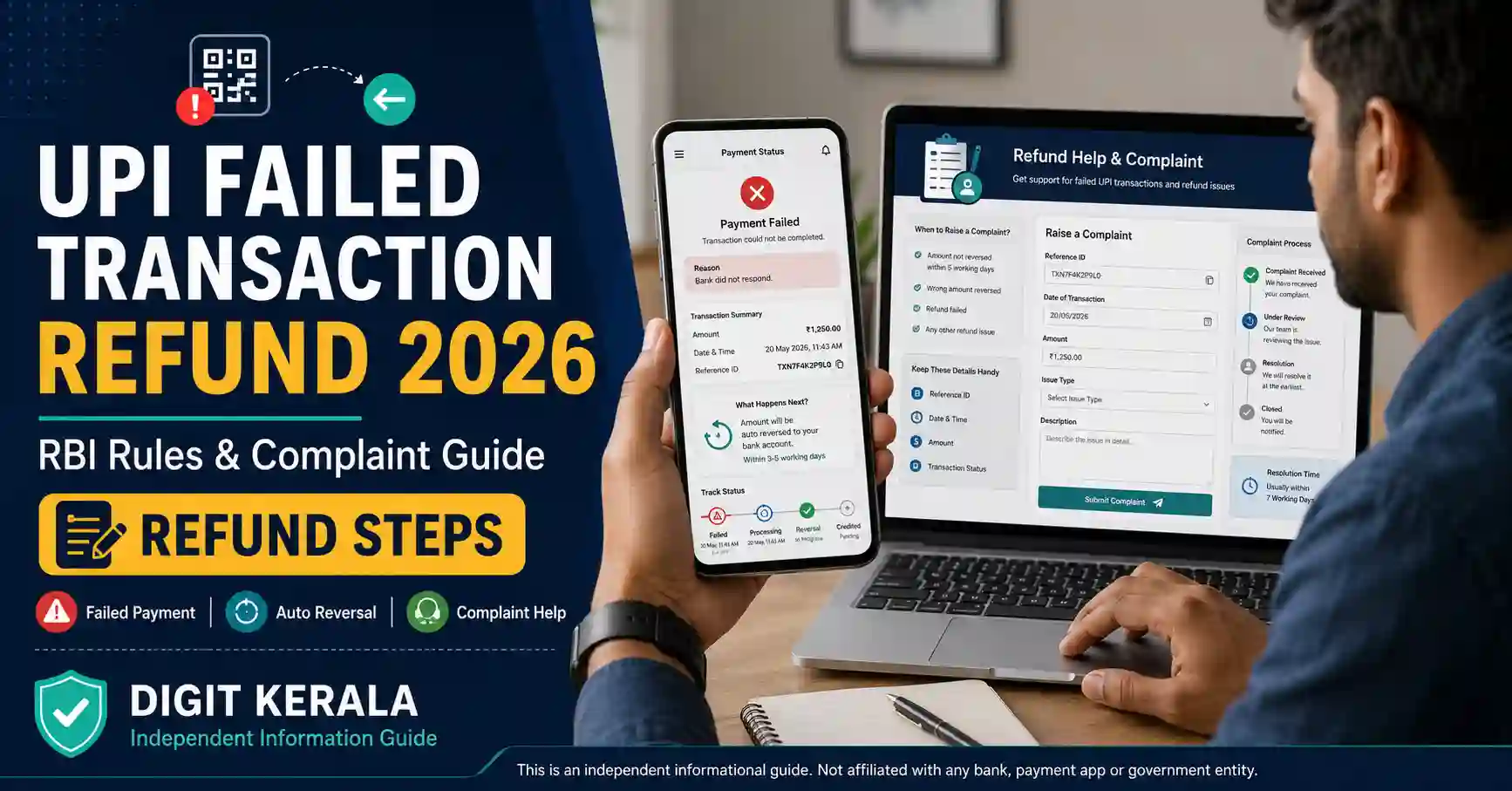
A UPI payment can occasionally fail even after the customer’s bank account has been debited.
Depending on the transaction type, RBI’s failed-transaction framework prescribes an outer timeline for completing the payment or reversing the amount.
For an eligible UPI fund transfer where the sender’s account is debited but the beneficiary is not credited, the applicable auto-reversal timeline is generally T+1 day.
For an eligible merchant payment where the account is debited but transaction confirmation is not received at the merchant location, the applicable auto-reversal timeline is generally T+5 days.
Here, “T” means the calendar date on which the transaction occurred.
Important: These timelines apply to eligible failed transactions caused by reasons not attributable to the customer. They do not automatically apply to payments sent to the wrong person, authorised scam payments, merchant-initiated refunds or transactions successfully credited to the recipient.
What Is a Failed UPI Transaction?
RBI describes a failed transaction as a transaction that was not fully completed because of a reason not attributable to the customer.
Possible reasons can include:
- Communication-link failure.
- Bank-server problem.
- UPI system timeout.
- Failure to credit the beneficiary.
- Delay in initiating a reversal.
- Incomplete transaction information.
- Technical interruption during processing.
A payment is not necessarily a failed transaction merely because the customer regrets making it or later discovers that the recipient was incorrect.
Understanding UPI Transaction Status
A UPI application may display one of several transaction statuses.
Successful
A successful status normally indicates that the payment was completed through the payment system.
If the recipient or merchant claims that the money was not received, the customer should preserve the transaction reference and ask the bank or UPI service provider to verify the actual credit status.
Do not make a second payment until the first transaction has been checked.
Failed
A failed status indicates that the transaction could not be completed.
If the account was not debited, no refund may be required.
If the account was debited, the amount should be reversed according to the applicable transaction category and RBI framework.
Pending or Processing
A pending status means that the final result is not yet available.
The transaction may later:
- Become successful.
- Be marked failed.
- Be automatically reversed.
- Require a complaint if the status remains unresolved.
Avoid repeating the same payment immediately unless the recipient and bank confirm that the first transaction was not completed.
RBI Refund Timeline for Failed UPI Transactions
RBI’s harmonised Turn Around Time framework provides different timelines based on the nature of the failed transaction.
| Failed UPI transaction type | Outer auto-reversal timeline | Delay compensation |
|---|---|---|
| Account debited but beneficiary not credited during a fund transfer | T+1 day | ₹100 per day beyond T+1 |
| Account debited but confirmation not received at merchant location | T+5 days | ₹100 per day beyond T+5 |
“T” refers to the calendar date of the transaction.
For example, if an eligible person-to-person transaction fails on August 10, the T+1 outer timeline ordinarily ends on August 11.
The timeline is an outer limit. Banks and payment-system participants are expected to work towards quicker resolution.
T+1 Rule for UPI Fund Transfers
The T+1 rule generally applies when:
- The sender’s bank account is debited.
- The transaction is a transfer of funds.
- The beneficiary’s account is not credited.
- The transaction failure is not attributable to the customer.
If the beneficiary cannot be credited, the applicable bank is required to complete the auto-reversal by T+1.
This can include certain person-to-person UPI transfers.
Check the transaction status and beneficiary’s account information before concluding that no credit occurred. An SMS delay alone does not always mean that the account was not credited.
T+5 Rule for Merchant Payments
The T+5 rule generally applies when:
- The customer’s account is debited.
- The payment was made to a merchant.
- Transaction confirmation was not received at the merchant location.
The eligible failed payment should be automatically reversed within T+5 days.
This category can arise when a customer pays at a store or online checkout, but the merchant system does not receive confirmation.
If the payment status is shown as successful and the merchant has received the money, the transaction is not treated as a failed merchant payment merely because an order was later cancelled.
₹100 Per Day Delay Compensation
RBI’s framework provides compensation of ₹100 per day when an eligible failed UPI transaction is not reversed within the applicable outer timeline.
The delay is calculated:
- Beyond T+1 for an eligible beneficiary-not-credited fund transfer.
- Beyond T+5 for an eligible merchant-confirmation failure.
The RBI circular states that applicable compensation should be credited automatically without waiting for the customer to make a separate claim.
If the reversal or compensation is not credited, the customer should raise a written complaint with the bank or payment service provider.
The ₹100 amount is compensation for delay. It is not a fixed bonus available for every failed transaction.
Is Refund Guaranteed in Every UPI Dispute?
No.
A reversal depends on the transaction’s actual status and reason.
Automatic failed-transaction rules may not apply when:
- The beneficiary was successfully credited.
- The customer entered an incorrect UPI ID.
- The customer knowingly approved the payment.
- A scammer persuaded the customer to enter the UPI PIN.
- The complaint concerns the quality of goods or services.
- A merchant accepted payment and later cancelled the order.
- The refund is being separately processed by the merchant.
- The customer is disputing a legitimate subscription or mandate.
- The transaction was outside the authorised domestic framework.
- The issue was caused by customer action rather than system failure.
The bank and payment-system records are used to determine whether the transaction actually failed.
What to Do Immediately After a Failed UPI Payment
Follow these steps:
- Open the UPI application’s transaction-history section.
- Check whether the status is successful, failed or pending.
- Save the UPI transaction ID or reference number.
- Take a screenshot without exposing the UPI PIN.
- Check the linked bank-account statement.
- Ask the beneficiary or merchant to verify the account credit.
- Avoid making the same payment again immediately.
- Use the in-app complaint or help option.
- Save the complaint or ticket number.
- Monitor the linked bank account for the reversal.
Do not share a screenshot containing sensitive account or personal information publicly.
Information Required for a Complaint
Keep the following ready:
- Customer’s name.
- Registered mobile number.
- Name of UPI application.
- Name of linked bank.
- Transaction date and time.
- Transaction amount.
- UPI transaction ID.
- Bank reference or UTR number, when displayed.
- Beneficiary or merchant UPI information.
- Screenshot of transaction status.
- Bank statement showing the debit.
- Complaint number generated by the application.
- Description of the issue.
- Date on which the applicable reversal timeline expired.
Never include the UPI PIN, debit-card PIN, CVV, password or OTP.
How to Raise a Complaint Through the UPI Application
Most UPI applications provide a complaint facility within the transaction-history section.
The general process is:
- Open the UPI application.
- Select transaction history.
- Open the disputed transaction.
- Select Help, Report an Issue or a similar option.
- Choose the correct issue category.
- Confirm whether the account was debited.
- Enter the requested information.
- Submit the complaint.
- Save the ticket number.
- Check the complaint status regularly.
Button names differ between applications.
Choose an option such as “account debited but beneficiary not credited” only when it accurately describes what happened.
Contacting the Bank
If the in-app complaint does not resolve the issue, contact the bank linked to the UPI payment.
Use:
- Bank’s official mobile application.
- Internet-banking grievance facility.
- Official customer-care number.
- Customer-care email.
- Branch complaint channel.
- Bank’s nodal or grievance officer.
Provide the transaction and complaint references.
Ask the bank to confirm:
- Whether the beneficiary was credited.
- Whether the transaction was reversed.
- Date on which reversal was initiated.
- Applicable RBI TAT category.
- Whether delay compensation was credited.
Obtain a written complaint acknowledgement.
NPCI UPI Help
NPCI provides an official UPI Help facility for supported transaction-status checks and complaints:
Follow the current instructions displayed on the NPCI platform.
The facility may request information such as:
- Registered mobile number.
- Bank name.
- UPI transaction reference.
- Transaction date.
- Transaction amount.
- Complaint category.
Do not use a third-party website merely because it contains “NPCI” or “UPI help” in its name.
Escalation Process
A practical escalation order is:
- Raise the dispute through the UPI application.
- Contact the linked bank or relevant payment service provider.
- Use the official NPCI complaint facility where applicable.
- Escalate to the bank’s grievance or nodal officer.
- Use RBI CMS if the eligible complaint remains unresolved.
Keep every ticket number and response.
Do not create multiple complaints with different descriptions for the same transaction.
RBI Complaint Management System
If an eligible complaint is not resolved by the concerned regulated entity, the customer may use the RBI Complaint Management System:
RBI Complaint Management System
Under the Reserve Bank–Integrated Ombudsman Scheme, 2026, customers must first complain to the concerned regulated entity.
An RBI complaint may generally be filed when:
- No response is received within 30 days or the longer applicable RBI, NPCI or card-network timeline; or
- The institution provides a response or resolution that is not satisfactory.
The RBI Ombudsman complaint must be filed within 90 days from:
- Expiry of the applicable response timeline; or
- Date of the institution’s last communication,
whichever is later.
RBI CMS is free. Filing a complaint does not guarantee a refund, compensation or decision in favour of the customer.
Merchant Refund and Failed Payment Are Different
A merchant refund is different from an automatic reversal of a failed transaction.
Failed-Transaction Reversal
This applies when the payment did not complete and the amount needs to be returned under the payment-system process.
Merchant Refund
This may apply when:
- The original payment was successful.
- The merchant received the money.
- An order was cancelled.
- Goods were returned.
- A service was not provided.
- The merchant agreed to issue a refund.
Merchant refunds may follow the merchant, payment aggregator and bank’s applicable processing timeline.
The UPI T+1 or T+5 failed-transaction timeline should not automatically be applied to every merchant refund.
Wrong UPI Transfer
A payment sent to an incorrect UPI ID is not normally a failed transaction if the recipient was successfully credited.
Take immediate action:
- Contact the bank.
- Raise a dispute in the UPI application.
- Provide the transaction reference.
- Request the bank’s assistance in contacting the beneficiary bank.
- Preserve all communications.
A bank may not be able to debit the recipient’s account without consent or lawful authority.
Do not contact or threaten an unknown recipient using information obtained from unofficial sources.
UPI Fraud and Scam Payments
A fraudulent UPI payment requires urgent action.
Immediately:
- Inform the linked bank.
- Request blocking or protective action.
- Report through the UPI application.
- Call the National Cyber Crime Helpline at 1930.
- File a complaint at the National Cyber Crime Reporting Portal.
- Preserve transaction IDs, telephone numbers, messages and screenshots.
- Change compromised credentials where required.
RBI failed-transaction timelines are not a substitute for immediate cyber-fraud reporting.
Do not wait for T+1 or T+5 if the transaction involves suspected fraud.
UPI Collect-Request Fraud
Receiving money through UPI does not require entering a UPI PIN.
The UPI PIN is generally used to authorise a debit from the customer’s account.
Be cautious when an unknown person asks the customer to:
- Approve a collect request.
- Scan a QR code to receive a refund.
- Enter a UPI PIN to receive money.
- Install a screen-sharing application.
- Share an OTP.
- Complete “KYC” through an unknown link.
A collect request approved by the customer may result in a debit and may not be treated as a failed transaction.
Duplicate UPI Debit
A duplicate debit can occur when a payment appears to have been charged more than once.
Check:
- Whether two separate transaction IDs were generated.
- Whether both transactions were successful.
- Whether one is pending or reversed.
- Whether the merchant received one or two credits.
Raise a separate complaint for the additional transaction and provide both references.
Do not rely only on SMS messages; confirm the debit through the bank statement.
Common Reasons Refunds Are Delayed
Possible reasons include:
- Transaction remains pending.
- Beneficiary-bank confirmation is incomplete.
- Merchant and bank records differ.
- Incorrect complaint category selected.
- Bank and UPI application use different reference numbers.
- Customer submitted incomplete information.
- The transaction was successful rather than failed.
- Merchant refund is being confused with auto-reversal.
- Bank-account information has changed.
- Technical reconciliation is pending.
- Complaint was submitted to the wrong institution.
Request a written status rather than relying only on verbal assurances.
Common Mistakes to Avoid
Avoid these mistakes:
- Paying the same merchant twice.
- Deleting the transaction screenshot.
- Sharing the UPI PIN with customer care.
- Submitting a complaint without the transaction ID.
- Claiming a T+1 refund for every merchant payment.
- Treating a merchant refund as a failed transaction.
- Waiting several days before reporting cyber fraud.
- Paying an agent to recover the money.
- Using an unofficial NPCI complaint website.
- Filing directly with RBI without first approaching the bank.
- Making unsupported compensation claims.
- Publishing account statements on social media.
Frequently Asked Questions
How long does a failed UPI refund take?
An eligible fund transfer where the account was debited but the beneficiary was not credited generally has a T+1 auto-reversal timeline. An eligible merchant-confirmation failure generally has a T+5 timeline.
What does T mean?
T means the calendar date on which the transaction occurred.
Is ₹100 compensation available for every failed payment?
No. It applies when an eligible failed transaction is not reversed within the prescribed outer timeline.
Must the customer separately request compensation?
RBI states that applicable compensation should be credited automatically. If it is not received, raise a written complaint.
What if the transaction is pending?
Check the transaction history, bank statement and beneficiary credit. Raise an in-app complaint if it remains unresolved and avoid making a duplicate payment.
What if money was sent to the wrong UPI ID?
Contact the bank and UPI application immediately. A successfully credited wrong transfer is not an automatic failed-transaction reversal.
Should a scam victim wait for the refund timeline?
No. Immediately contact the bank, call 1930 and report through the National Cyber Crime Reporting Portal.
Can NPCI return the money directly?
NPCI provides complaint and transaction-support facilities. Actual reversal or dispute resolution involves the relevant banks and payment-system participants.
Can an RBI complaint be filed immediately?
The bank or regulated entity must be approached first. RBI CMS eligibility is subject to the current Ombudsman rules and applicable waiting period.
Is RBI CMS free?
Yes. There is no RBI complaint-filing fee.
Official References
- RBI Failed-Transaction TAT and Compensation Framework
- NPCI UPI Help
- NPCI UPI Information
- RBI Complaint Management System
- RBI Integrated Ombudsman Scheme 2026 FAQ
- National Cyber Crime Reporting Portal
Last reviewed: August 30, 2026.
Financial disclaimer: DIGIT KERALA is an independent information website and is not affiliated with RBI, NPCI, any bank, UPI application, payment provider or government organisation. This article provides general information and does not constitute financial or legal advice. Transaction status, refund eligibility, processing time and complaint procedures depend on the facts and applicable rules. Refund, compensation and complaint approval are not guaranteed. Always verify information through the official bank, NPCI and RBI channels.