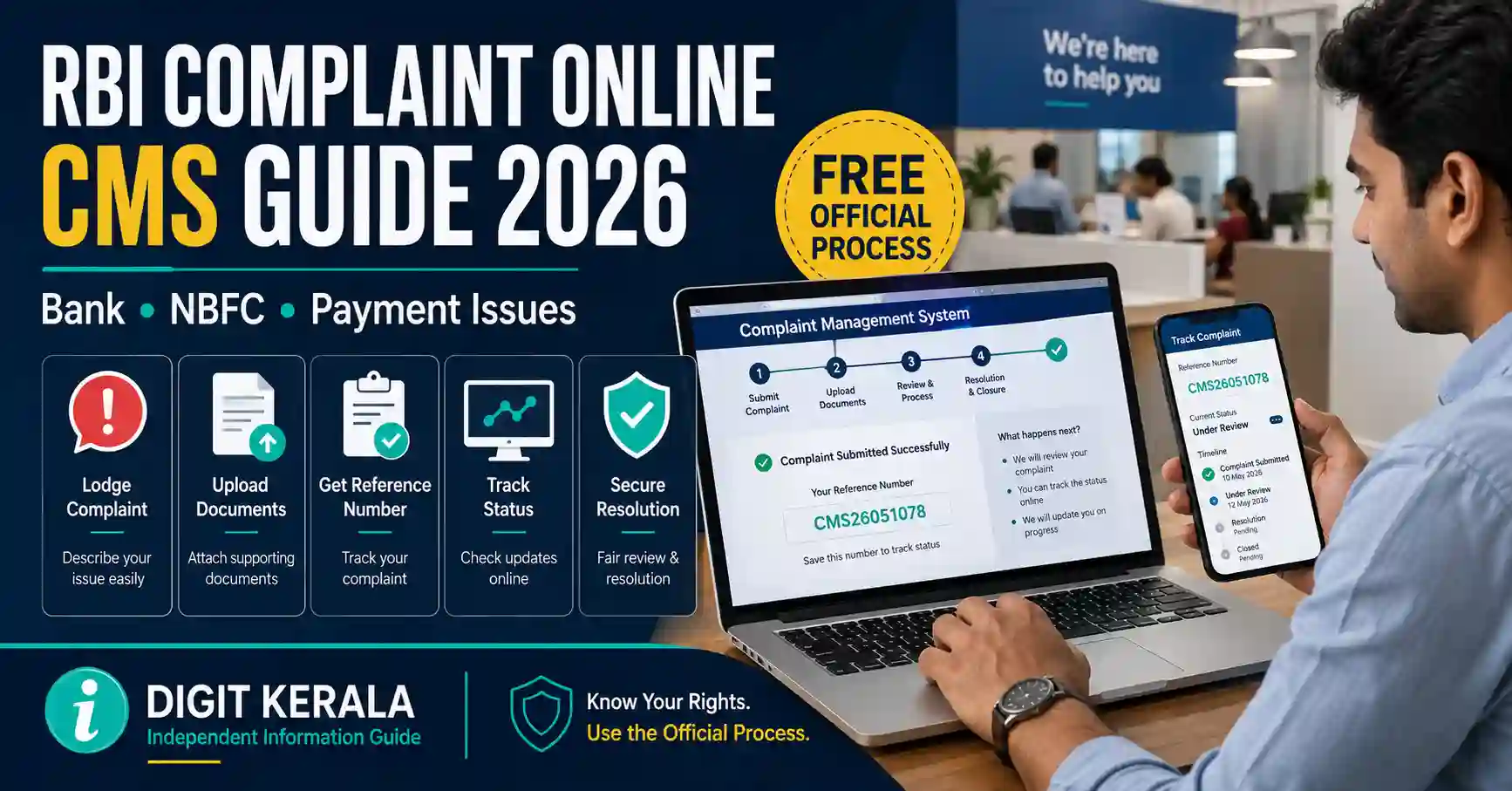
Customers who are unable to resolve a complaint with a bank, eligible NBFC, prepaid-payment issuer or Credit Information Company can use the Reserve Bank of India’s Complaint Management System.
The RBI CMS portal provides a centralised facility for filing and tracking eligible complaints under the Reserve Bank–Integrated Ombudsman Scheme, 2026.
The service is free. Customers do not need to pay an agent, lawyer or private complaint-handling company to submit a complaint.
However, customers must normally complain to the concerned financial institution first. An RBI Ombudsman complaint filed without first approaching the institution may be treated as non-maintainable.
Important: RBI CMS is a grievance-redress mechanism. Filing a complaint does not guarantee a refund, compensation, loan approval, reversal of charges or a decision in favour of the complainant.
What Is the RBI Complaint Management System?
The Complaint Management System, commonly known as RBI CMS, is the Reserve Bank of India’s official platform for receiving and processing eligible customer complaints.
Customers can use the portal to:
- File an eligible complaint.
- Upload supporting documents.
- Receive a complaint number.
- Track complaint status.
- Respond to requests for additional information.
- Withdraw a complaint.
- Use the appeal facility when permitted under the scheme.
The official portal is:
RBI Complaint Management System
Check that the website address ends in rbi.org.in before entering account, card, loan or transaction information.
RBI Integrated Ombudsman Scheme 2026
The Reserve Bank–Integrated Ombudsman Scheme, 2026 came into effect on July 1, 2026.
It replaced the Reserve Bank–Integrated Ombudsman Scheme, 2021 for complaints received from July 1, 2026.
Complaints submitted before that date and appeals or awards connected with the previous scheme continue to be handled according to the applicable earlier provisions.
The 2026 scheme provides a cost-free and non-adversarial mechanism for resolving eligible complaints involving deficiency in service by covered RBI-regulated entities.
What Is Deficiency in Service?
Under the scheme, deficiency in service means a shortcoming or inadequacy in a service that a covered financial institution is required to provide.
A deficiency may or may not cause direct financial loss.
Examples may include situations involving:
- Failure to follow an applicable banking instruction.
- Unexplained or incorrectly applied charges.
- Unreasonable delay in providing an eligible service.
- Failure to address an unauthorised transaction complaint.
- Delay in resolving eligible ATM or payment complaints.
- Incorrect account or loan servicing.
- Failure to update eligible customer information.
- Incorrect credit information that remains unresolved.
- Non-response to a written customer complaint.
Whether a particular incident amounts to deficiency in service is determined from the facts, documents and applicable RBI instructions.
Which Financial Institutions Are Covered?
The major categories covered under the RBI Integrated Ombudsman Scheme, 2026 include the following.
Banks
The scheme covers:
- Commercial banks.
- Regional Rural Banks.
- State Co-operative Banks.
- Central Co-operative Banks.
- Scheduled Primary Urban Co-operative Banks.
- Eligible Non-Scheduled Primary Urban Co-operative Banks.
For a Non-Scheduled Primary Urban Co-operative Bank, the applicable deposit-size condition under the scheme must be satisfied.
Non-Banking Financial Companies
The scheme covers eligible RBI-registered NBFCs that:
- Are authorised to accept deposits; or
- Have customer interface and meet the applicable asset-size requirement.
Certain categories—including Housing Finance Companies and other excluded NBFC categories listed by RBI—are not covered under this Ombudsman Scheme.
A complaint against an excluded but RBI-regulated entity may be processed through another applicable RBI grievance arrangement, such as a Consumer Education and Protection Cell.
Other Covered Entities
The scheme also covers:
- Non-bank Prepaid Payment Instrument issuers.
- Credit Information Companies.
Credit Information Companies include organisations maintaining eligible credit-information records. The exact maintainability of a credit-report complaint depends on the facts and applicable legislation.
Complaints That May Be Filed
Subject to eligibility and verification, customers may use RBI CMS for unresolved service complaints relating to areas such as:
- Savings or current accounts.
- Fixed or recurring deposits.
- ATM cash-withdrawal disputes.
- Debit-card transactions.
- Credit-card servicing.
- Internet or mobile banking.
- Eligible UPI or payment transactions.
- Unauthorised electronic transactions.
- Bank charges.
- Loan-account servicing.
- Recovery-agent conduct covered by RBI requirements.
- Delay in account closure.
- Delay in releasing eligible documents after loan closure.
- Incorrect credit-report information.
- Prepaid wallets or eligible payment instruments.
- Another service deficiency involving a covered entity.
This list does not mean that every complaint in these categories will be accepted or decided in the customer’s favour.
First Complain to the Bank or Financial Institution
A customer must first submit the complaint directly to the concerned regulated entity.
The complaint can generally be made through:
- Official grievance web page.
- Bank or NBFC mobile application.
- Customer-care email.
- Branch complaint register.
- Written complaint submitted at the branch.
- Institution’s nodal or grievance officer.
- Another official complaint channel.
Obtain and preserve:
- Complaint reference number.
- Acknowledgement.
- Date of complaint.
- Copy of the email or letter.
- Screenshot of online submission.
- Institution’s reply, if received.
A phone conversation without a complaint number or written record may be difficult to prove.
When Can an RBI Complaint Be Filed?
An RBI Ombudsman complaint can generally be filed when:
- The institution provides a reply or resolution that is not satisfactory; or
- The institution fails to reply within 30 days or within a longer timeline specified by RBI, NPCI or the applicable card-network guidelines.
If the institution has already provided a final response and the customer is dissatisfied, it may not always be necessary to wait for the full 30 days.
For payment disputes, a longer timeline prescribed under an applicable RBI, NPCI or card-network rule may need to expire first.
Important 90-Day Complaint Deadline
Under the RBI Integrated Ombudsman Scheme, 2026, the customer must file the complaint with the RBI Ombudsman within 90 days from:
- The date on which the institution’s applicable response timeline expires; or
- The date of the institution’s last communication concerning the complaint,
whichever is later.
This is different from the time limit under the previous 2021 scheme.
The original complaint to the financial institution must also have been made within the limitation period prescribed under the Limitation Act, 1963.
Customers should not unnecessarily delay an RBI complaint after completing the institution’s complaint process.
Information Required for Filing a Complaint
Keep the following information ready:
- Complainant’s full name.
- Active mobile number.
- Email address, if available.
- Complete postal address.
- Name of the bank, NBFC or other regulated entity.
- Branch or office details, when applicable.
- Institution’s complaint or acknowledgement number.
- Date on which the institution was first contacted.
- Copy of the original complaint.
- Institution’s response, if received.
- Account, card or loan details relevant to the complaint.
- Transaction date and reference number.
- Description of what happened.
- Amount of the claimed financial loss.
- Explanation of the inconvenience caused.
- Specific relief requested.
- Supporting documents.
Do not upload unrelated personal documents.
Sensitive details such as PINs, CVVs, internet-banking passwords and OTPs should never be included.
Supporting Documents
Depending on the complaint, useful documents may include:
- Bank statement showing the disputed transaction.
- Transaction receipt.
- UPI or payment reference number.
- ATM transaction information.
- Credit-card statement.
- Loan statement.
- Account-closure request.
- Copy of the customer’s written complaint.
- Bank or NBFC acknowledgement.
- Final response from the institution.
- Relevant emails or messages.
- Supporting screenshots.
- Credit report and correction request.
- Proof of the actual financial loss claimed.
Documents should be readable and directly relevant to the complaint.
Edited screenshots or incomplete statements may weaken the complaint.
How to File an RBI Complaint Online
Follow these general steps:
- Visit the official RBI CMS portal.
- Select the option to file a complaint.
- Read the instructions and confirm that the institution was approached first.
- Enter the complainant’s name, mobile number and address.
- Complete the requested mobile or email verification.
- Select the correct regulated entity.
- Enter the institution’s complaint number and complaint date.
- Provide the account, card, loan or transaction information.
- Explain the issue in chronological order.
- Enter the loss or disputed amount accurately.
- State the specific relief requested.
- Upload the original complaint, response and supporting documents.
- Review every entry.
- Submit the complaint.
- Save the complaint number and acknowledgement.
Portal fields can change. Follow the current instructions displayed on the official CMS website.
How to Write the Complaint Description
The complaint description should be factual, specific and easy to verify.
A clear description can follow this order:
- Name of the financial institution.
- Relevant account or product type.
- Date and nature of the disputed incident.
- Transaction reference, where applicable.
- Date on which the institution was first contacted.
- Complaint number issued by the institution.
- Reply received or confirmation that no reply was received.
- Exact financial loss or inconvenience.
- Specific resolution requested.
Avoid threats, abusive language and unsupported allegations.
Do not describe a general dissatisfaction without identifying a specific service deficiency.
Filing a Complaint by Email
A complaint can also be sent to the Centralised Receipt and Processing Centre at:
crpc@rbi.org.in
The email should contain all required complaint information and relevant supporting documents.
Use a clear subject such as:
Complaint Against [Name of Regulated Entity] – Complaint Reference [Number]
Sending an email does not remove the requirement to complain to the institution first.
Filing a Physical Complaint
A signed physical complaint can be sent with supporting documents to:
Centralised Receipt and Processing Centre
Reserve Bank of India
Central Vista, Sector 17
Chandigarh – 160017
Use the complaint format prescribed under the current scheme.
Keep copies of the complete complaint and postal receipt.
Do not send original passbooks, property deeds, cards or other documents that may be difficult to replace.
Is There Any Complaint Fee?
No.
RBI does not charge a fee for filing or resolving a complaint under the Integrated Ombudsman Scheme, 2026.
Customers do not need to engage a private agent or lawyer to submit the complaint.
Be cautious if anyone asks for:
- RBI registration charge.
- Ombudsman processing fee.
- Refund-release fee.
- Compensation tax paid in advance.
- Security deposit.
- Payment to obtain priority processing.
Such demands are not part of the official CMS complaint process.
Can a Representative File the Complaint?
A complaint may be submitted through a duly authorised representative.
The representative must have written authorisation from the complainant.
An advocate cannot ordinarily act as the authorised representative under this process unless the advocate is personally the aggrieved complainant.
The complainant can also file directly without a representative.
How to Track RBI Complaint Status
After successful registration, RBI provides a complaint number.
To check the status:
- Visit the official CMS portal.
- Select Track a Complaint.
- Enter the complaint number.
- Enter the registered mobile number.
- Complete the requested verification.
- Review the displayed status.
Customers may also contact the RBI Contact Centre on toll-free number 14448 for guidance and status-related assistance.
The IVRS facility is available 24 hours a day.
According to the RBI FAQ, access to Contact Centre personnel is available from 8:00 AM to 10:00 PM, Monday to Saturday, except national holidays.
Support is provided in English, Hindi and ten regional languages, including Malayalam.
The Contact Centre provides guidance but does not directly file the complaint for the customer.
What Happens After Submission?
RBI first checks whether the complaint is maintainable under the scheme.
If maintainable, it may be forwarded to the concerned regulated entity for a response.
The Ombudsman Office may examine:
- Customer’s complaint.
- Institution’s response.
- Supporting documents submitted by both sides.
- Applicable RBI directions.
- Banking law and practice.
- Evidence of financial loss or inconvenience.
- Resolution proposed by the institution.
The complaint may be resolved through settlement, an Award or rejection.
Resolution Through Settlement
RBI Ombudsman or Deputy Ombudsman may facilitate a mutually acceptable resolution between the customer and the financial institution.
This can involve:
- Facilitation.
- Advisory.
- Conciliation.
- Acceptance of a resolution proposed by the institution.
If the complainant accepts the settlement, the complaint is closed accordingly.
Read the terms carefully before accepting a full-and-final settlement.
RBI Ombudsman Award
If the complaint is not settled and the RBI Ombudsman finds a deficiency in service, an Award may be passed.
The Award may direct the regulated entity to:
- Correct the service deficiency.
- Reverse an eligible charge.
- Take another specified remedial action.
- Pay admissible compensation.
An Award is based on the evidence and circumstances of the individual complaint. Similar-looking complaints may receive different decisions.
Compensation Limits Under the 2026 Scheme
There is no monetary limit on the total amount involved in a dispute that can be brought before the RBI Ombudsman.
However, the Ombudsman’s compensation powers are subject to limits.
The RBI Ombudsman may provide:
- Up to ₹30 lakh for consequential loss suffered by the complainant.
- Up to ₹3 lakh for loss of time, expenses, harassment or mental anguish.
These are maximum limits and not fixed compensation amounts.
The complainant must provide relevant facts and evidence. Filing a complaint does not automatically create a right to compensation.
Do not use exaggerated or unsupported compensation amounts merely because the scheme provides a maximum limit.
Acceptance and Compliance With an Award
When an Award is issued, the complainant must normally provide a letter accepting the Award in full and final settlement within 30 days of receiving it, unless an appeal has been filed.
The regulated entity must comply with the Award or file a permitted appeal within the applicable period.
Follow the instructions included with the Award carefully.
Appeal Rules Under RB-IOS 2026
Under the 2026 scheme, an appeal is available only against an Award passed by the RBI Ombudsman.
A complainant aggrieved by an Award can file an appeal before the Appellate Authority within 30 days of receiving the Award.
The Appellate Authority may allow an additional period of up to 30 days when sufficient reason for the delay is established.
A routine rejection or closure does not automatically carry an appeal right under this scheme.
The CMS portal provides the supported appeal facility.
The Appellate Authority may:
- Dismiss the appeal.
- Set aside the Award.
- Return the case to the Ombudsman for fresh consideration.
- Modify the Award.
- Issue another permissible direction.
Complaints That May Not Be Accepted
A complaint may be treated as non-maintainable when:
- The customer did not first complain to the financial institution.
- Proof of the original complaint is unavailable.
- The required waiting period has not expired.
- The 90-day RBI complaint deadline has passed.
- Required information is incomplete.
- The complaint is abusive, frivolous or vexatious.
- The same grievance is already pending before the Ombudsman.
- The same matter is before or has been decided by a court, tribunal, arbitrator or another judicial forum.
- The complaint concerns the institution’s commercial judgment.
- It is a dispute between a vendor and financial institution.
- It concerns an employee-employer relationship.
- The service is outside RBI’s regulatory authority.
- The institution or customer category is not covered.
- The complaint is merely a question, suggestion or request for general guidance.
- The complainant does not actively cooperate with the examination.
- Extensive oral and documentary evidence requiring formal adjudication is necessary.
The Ombudsman may also reject a complaint if no deficiency, loss, damage or inconvenience is established.
Commercial Decisions and Service Deficiency
RBI Ombudsman does not ordinarily replace the commercial judgment of a bank or NBFC.
For example, the following may involve commercial decisions:
- Whether to approve a loan.
- Amount of credit sanctioned.
- Credit-card limit.
- Loan pricing within applicable rules.
- Risk assessment.
- Acceptance of a customer relationship.
A complaint saying only that a loan was rejected may not be maintainable.
However, a complaint about failure to follow applicable rules, lack of required communication or another identifiable service deficiency may be examined based on its facts.
Online Fraud and Unauthorised Transactions
RBI CMS should not be treated as an emergency fraud-reporting service.
If an unauthorised transaction occurs:
- Inform the bank or payment provider immediately.
- Block the affected card, account access or payment instrument.
- Preserve transaction messages and references.
- Follow the institution’s fraud-reporting procedure.
- Report cybercrime through the official government mechanism where applicable.
- File the RBI complaint later if the institution does not resolve the service complaint according to the applicable requirements.
Never delay immediate fraud reporting while waiting to prepare an Ombudsman complaint.
Common Filing Mistakes
Avoid these common problems:
- Filing directly with RBI without contacting the bank.
- Entering the customer-care call date without a written complaint reference.
- Selecting the wrong financial institution.
- Uploading unclear statements.
- Hiding the institution’s response.
- Missing the 90-day deadline.
- Including PINs, CVVs or passwords.
- Submitting multiple complaints about the same issue.
- Using abusive or threatening language.
- Asking for an unsupported compensation amount.
- Filing the same dispute simultaneously before multiple adjudicatory forums.
- Paying an unofficial complaint agent.
Review the application carefully before submission.
Fraud-Prevention Tips
Fraudsters may misuse the names of RBI, banks and Ombudsman offices.
Follow these precautions:
- Use only
cms.rbi.org.in. - Never share OTPs, PINs or passwords.
- Do not install remote-access applications.
- Do not respond to unknown “request money” notifications.
- Never pay a fee to release a refund or compensation.
- Do not trust callers promising an immediate Ombudsman Award.
- Verify suspicious communication through official RBI channels.
- Do not publish the complaint number and account details publicly.
- Keep uploaded documents securely.
- Check the recipient before emailing documents.
RBI does not guarantee refunds or compensation through unsolicited phone calls or social-media messages.
Frequently Asked Questions
Can I complain directly to RBI without contacting the bank?
Normally, no. The customer must first complain to the concerned regulated entity and retain proof.
Must I always wait 30 days?
If no response is received, the customer generally waits 30 days or the longer applicable timeline. If the institution provides a response earlier and the customer is dissatisfied, a complaint may be filed without waiting for the remaining period.
What is the current RBI complaint deadline?
Under RB-IOS 2026, the complaint must be filed within 90 days from the expiry of the applicable response timeline or the institution’s last communication, whichever is later.
Is RBI CMS free?
Yes. RBI does not charge a complaint or resolution fee.
Can I file a complaint in Malayalam?
The main CMS form supports Hindi and English. RBI states that the complaint description may be entered in another language, subject to the portal’s character limit. Email and physical complaints may be submitted in any language.
Can the RBI Ombudsman force a bank to approve a loan?
The Ombudsman does not ordinarily interfere with legitimate commercial decisions such as credit approval. It examines eligible service deficiencies.
Is compensation guaranteed?
No. Compensation depends on the facts, evidence, proven loss and Ombudsman’s decision.
Can I complain about an NBFC?
Eligible RBI-registered NBFCs covered by the scheme can be selected. Certain NBFC categories are excluded and may fall under another grievance arrangement.
How can I check the complaint status?
Use the complaint number and registered mobile number through the CMS Track a Complaint facility.
Can I withdraw a complaint?
Yes. A registered complaint can be voluntarily withdrawn through the supported option under Track a Complaint.
Can I appeal if my complaint is rejected?
Under RB-IOS 2026, the statutory appeal facility is available only against an Award. It is not automatically available against every rejection or closure.
Official References
- RBI Complaint Management System
- RBI Integrated Ombudsman Scheme 2026 FAQ
- RBI Integrated Ombudsman Scheme 2026 Document
- RBI Consumer Education and Protection Department
Last reviewed: August 30, 2026.
Financial and legal disclaimer: DIGIT KERALA is an independent information website and is not affiliated with the Reserve Bank of India, any bank, NBFC, payment provider or government organisation. This article provides general information and does not constitute financial or legal advice. Complaint eligibility, deadlines, portal features and regulatory requirements may change. Filing a complaint does not guarantee a refund, compensation or favourable decision. Verify current information through the official RBI website and obtain qualified professional advice when necessary.