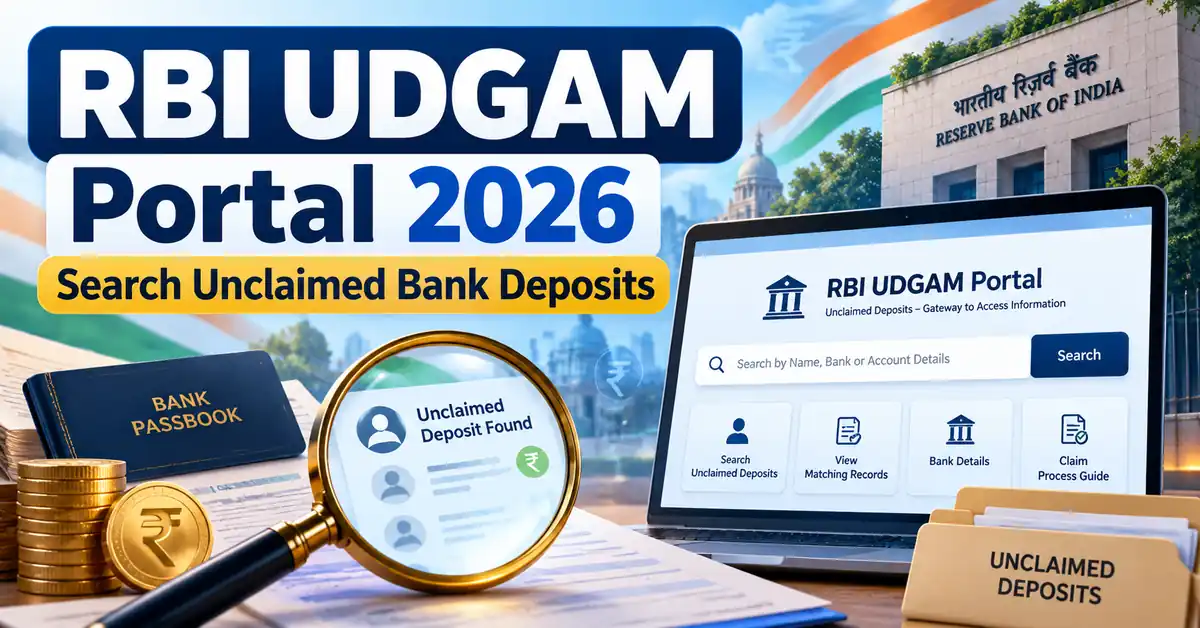
The Reserve Bank of India’s UDGAM portal helps members of the public search for unclaimed deposits across participating banks through a single official platform.
UDGAM stands for Unclaimed Deposits–Gateway to Access inforMation.
The portal can help depositors, nominees and legal heirs identify old bank accounts or deposits that have been transferred to the RBI’s Depositor Education and Awareness Fund.
However, UDGAM is only a search facility. A deposit cannot be claimed or withdrawn directly through the portal. The customer must approach the bank where the account or deposit was originally maintained.
Important: A successful UDGAM search does not automatically prove ownership or guarantee payment. The concerned bank must verify the claimant’s identity, account information and legal entitlement.
What Is an Unclaimed Bank Deposit?
A bank deposit generally becomes an unclaimed deposit when:
- A credit balance in a deposit account has remained unoperated for 10 years or more; or
- A deposit or another covered amount has remained unclaimed for 10 years or more.
This can include a fixed deposit that was not claimed within 10 years from its maturity date.
Banks transfer eligible unclaimed amounts to the Depositor Education and Awareness Fund maintained by RBI.
The transfer does not remove the depositor’s right to claim the money. The depositor or another eligible claimant can later approach the concerned bank for settlement.
Inoperative Account and Unclaimed Deposit Are Different
An inoperative bank account is not automatically an unclaimed deposit.
Inoperative Account
A savings or current account is generally treated as inoperative when there have been no customer-induced transactions for more than two years.
Customer-induced transactions can include eligible financial or authenticated non-financial activities initiated by the customer.
Unclaimed Deposit
A deposit becomes unclaimed when the applicable balance or amount remains unoperated or unclaimed for 10 years or more.
The UDGAM portal is designed to search deposits that are part of the RBI Depositor Education and Awareness Fund. It is not intended to display every account that has merely become inactive for two years.
Customers with a recently inoperative account should contact their bank directly for reactivation.
What Is the Depositor Education and Awareness Fund?
The Depositor Education and Awareness Fund, or DEA Fund, is maintained by the Reserve Bank of India.
Banks transfer eligible amounts that have remained unclaimed for the prescribed period to this fund.
The bank remains responsible for handling the customer’s claim.
When an eligible depositor, nominee or legal heir submits a valid claim:
- The claimant approaches the concerned bank.
- The bank verifies the claimant and supporting documents.
- The bank settles the eligible claim.
- The bank obtains reimbursement from the DEA Fund according to the applicable procedure.
Customers do not submit a refund request directly to the DEA Fund.
Can Depositors Still Claim the Money?
Yes.
A depositor can claim an eligible unclaimed amount from the bank even after it has been transferred to the DEA Fund.
In the case of a deceased depositor, an eligible nominee or legal heir may submit a claim according to the bank’s deceased-depositor claim procedure.
The official DEA Fund FAQ states that no specific time limit has been prescribed for a depositor or claimant to request a refund. Nevertheless, customers should make the claim as soon as they discover the deposit.
Delaying a claim can make it more difficult to locate old documents, account information and legal-heir records.
What Can Be Searched Through UDGAM?
UDGAM can be used to search unclaimed deposits and accounts that:
- Have been transferred to the DEA Fund.
- Belong to a bank participating in the portal.
- Match the search details entered by the user.
The portal may cover eligible amounts relating to:
- Savings accounts.
- Current accounts.
- Fixed or term deposits.
- Recurring deposits.
- Certain unclaimed bank instruments.
- Other amounts covered under the DEA Fund Scheme.
The portal does not display all personal account information or the balance publicly.
Are All Banks Available on UDGAM?
Not every bank may be available on the portal.
RBI’s UDGAM FAQ previously stated that participating banks represented a substantial portion of the unclaimed deposits held in the DEA Fund. The number and list of participating banks may change.
Check the current bank list displayed on the official UDGAM portal.
If a bank is unavailable, customers can:
- Search the unclaimed-deposit facility on the bank’s official website.
- Contact the bank’s customer-care service.
- Contact an authorised branch.
- Check whether the bank has merged or changed its name.
- Ask the successor bank about old accounts.
Do not conclude that no deposit exists merely because the bank is not listed on UDGAM.
Official UDGAM Portal
The official portal is:
Check the full domain before registering.
The official address should end in:
rbi.org.in
Avoid websites using similar names such as “UDGAM help,” “unclaimed money agent” or “RBI refund service.”
Registration Details Required
A person must register before using the UDGAM search facility.
Registration generally requires:
- User’s name.
- Active mobile number.
- Mobile OTP.
- Password created according to the portal requirements.
Use a mobile number that remains accessible.
Do not share the OTP or portal password with an agent.
The person registering on UDGAM does not necessarily need to be the original depositor. The portal can be used to search for an eligible family member or entity using the required information.
However, the bank will later verify who is legally entitled to claim the deposit.
Details Required to Search for an Individual
To search an unclaimed deposit belonging to an individual, provide:
- Name of the account holder.
- Name of one or more participating banks.
- At least one available identification detail.
Accepted search information may include:
- PAN.
- Driving licence number.
- Voter ID number.
- Passport number.
- Date of birth.
Providing more accurate information can help narrow the results.
If none of these details is available, the portal allows the user to enter the account holder’s address for the search.
Use the depositor’s name as it was likely recorded when the account was opened. Try reasonable spelling variations if the original record is old.
Details Required for a Company or Other Entity
For a non-individual account, the search may require:
- Name of the entity.
- Name of one or more banks.
- Name of the authorised signatory.
- PAN.
- Corporate Identification Number.
- Date of incorporation.
If these details are unavailable, the entity’s recorded address may be used according to the portal facility.
Non-individual accounts can include eligible deposits maintained in the names of companies, firms, associations or other entities.
The bank may require current authorisation and entity documents before settling a claim.
How to Search Unclaimed Deposits Online
Follow these general steps:
- Visit the official UDGAM portal.
- Select the registration option if using the portal for the first time.
- Enter the user’s name and mobile number.
- Complete OTP verification.
- Create the required login password.
- Sign in to the UDGAM account.
- Choose the individual or non-individual search category.
- Enter the account holder’s or entity’s name.
- Select one or more banks.
- Enter an available search identifier.
- If an identifier is unavailable, enter the recorded address.
- Complete the security verification.
- Submit the search.
- Review the matching results.
- Note the Unclaimed Deposit Reference Number and bank information.
- Read the bank’s claim instructions shown with the result.
Portal screens and field names may change. Follow the latest instructions displayed on the official website.
What Is a UDRN?
UDRN means Unclaimed Deposit Reference Number.
It is a unique reference generated by the bank for an account or deposit transferred to the DEA Fund.
The UDRN is designed to help the bank process the claim while protecting sensitive information.
A public search result does not reveal details such as:
- Complete account number.
- Exact deposit balance.
- Full branch information.
- Account type in every case.
- Private customer documents.
Save the UDRN securely and provide it only through the bank’s official claim process.
A UDRN is not a withdrawal code and cannot be used to transfer money.
Does UDGAM Show the Deposit Amount?
The search facility does not publicly display the complete account number or outstanding balance.
The portal is intended to help identify a possible deposit and direct the user to the concerned bank.
The actual amount, interest and entitlement are confirmed only after bank verification.
Do not trust an agent who claims to know the exact balance merely from a UDGAM search result.
How to Claim an Unclaimed Deposit
After finding a matching result, review the claim instructions provided for the concerned bank.
The general process may involve:
- Visit the bank’s official unclaimed-deposit page.
- Download or request the applicable claim form.
- Contact the specified branch or another permitted branch.
- Provide the UDRN and known account information.
- Submit identity and address documents.
- Provide old account or deposit records when available.
- Complete current KYC requirements.
- Submit nominee or legal-heir documents when applicable.
- Allow the bank to verify the claim.
- Obtain an acknowledgement.
- Track the claim through the bank.
The claim process differs between banks. Follow the current instructions published by the concerned bank.
UDGAM does not process the payment.
Documents the Depositor May Need
For a claim by the original depositor, the bank may request:
- Completed claim form.
- Aadhaar or another accepted identity document.
- PAN.
- Address proof.
- Recent photograph.
- Old passbook.
- Fixed-deposit receipt.
- Account statement.
- Cheque book or account correspondence.
- UDGAM search result or UDRN.
- Current bank-account information.
- Updated KYC documents.
An old passbook or deposit receipt can help the bank locate the record, but the absence of an old document does not automatically mean that a valid claim is impossible.
The bank may use its internal records and complete additional verification.
Claim by a Nominee or Legal Heir
If the original depositor is deceased, the claimant should contact the bank’s deceased-depositor claim section.
Documents may include:
- Death certificate.
- Claim form.
- Nominee’s identity and address proof.
- Proof of relationship.
- Old passbook or deposit receipt.
- UDRN.
- Legal-heir certificate.
- Succession certificate.
- Probate, letter of administration or another legal document where applicable.
- Indemnity, declaration or affidavits required under the bank’s policy.
The exact requirements depend on:
- Whether a nominee was registered.
- Whether the account was jointly held.
- The mode of operation.
- The deposit amount.
- Whether there is a dispute between legal heirs.
- The bank’s claim-settlement policy.
- Applicable succession law.
A nominee may receive the amount from the bank in the permitted capacity, but legal ownership between heirs can involve separate succession considerations.
Obtain qualified legal advice if the family’s entitlement is disputed.
Reactivating an Inoperative Account
If the account has not yet become an unclaimed deposit, contact the bank for reactivation.
RBI instructions require banks to make KYC-updating facilities for activation available at all branches, including non-home branches.
Video Customer Identification Process may also be available if the bank provides that facility.
The bank must complete:
- Customer identification.
- Updated KYC.
- Customer due diligence.
- Required internal authorisation.
- Fraud-prevention checks.
According to RBI instructions, a complete request for activation of an inoperative account or unclaimed deposit should be processed within three working days.
This three-working-day requirement relates to activation after receipt of a complete application. It should not be interpreted as a guaranteed deadline for every deceased-depositor claim, disputed ownership case or refund settlement.
Charges for Account Reactivation
Banks are not permitted to charge a fee merely for activating an inoperative account.
Banks are also not permitted to levy penal charges for non-maintenance of minimum balance while the account is classified as inoperative.
Customers should request a written explanation if an unexplained activation fee is demanded.
Ordinary charges applicable after the account becomes operative may still apply according to the account terms and current bank policy.
Interest on Unclaimed Deposits
Savings-account interest should continue to be credited according to applicable requirements even when the account is inoperative.
When an eligible unclaimed amount is claimed, the bank repays the depositor or claimant with applicable interest for an interest-bearing deposit account.
The interest amount depends on the account or deposit type and the applicable RBI and bank rules.
Do not calculate an expected refund using an assumed interest rate without obtaining the bank’s confirmation.
What If No Result Is Found?
A missing result does not always mean that no old deposit exists.
Possible reasons include:
- The bank is not yet available on UDGAM.
- The name spelling does not match the old record.
- The account has not completed 10 years of unclaimed status.
- The account is inoperative but not transferred to the DEA Fund.
- Incorrect bank selected.
- Incorrect date of birth or identification number.
- Old bank merged with another bank.
- Address differs from the original account record.
- The account was already closed or settled.
- The deposit belongs to a different category.
- Bank records require manual verification.
Try searching with:
- Old and current name spellings.
- Previous address.
- Different participating banks.
- Date of birth.
- PAN or another available identifier.
If the search remains unsuccessful, contact the bank directly.
What If the Old Bank Has Merged?
Contact the successor bank that took over the old bank’s accounts and liabilities.
Provide:
- Old bank name.
- Old branch location.
- Approximate account-opening period.
- Depositor’s full name.
- Old account or deposit information.
- Identity and address records.
- Information about the merger when known.
Use only the successor bank’s official website or customer-care channel.
Do not send documents to an email address found on an unofficial directory.
Complaint About Delay or Rejection
First submit a written complaint through the bank’s official grievance mechanism.
Keep:
- Claim acknowledgement.
- Claim date.
- Copies of documents submitted.
- Complaint reference number.
- Bank’s response.
- Record of any additional documents requested.
If an eligible complaint involving service deficiency is not resolved according to the applicable requirements, the customer may consider the RBI Complaint Management System.
RBI Complaint Management System
An Ombudsman complaint is subject to the eligibility and deadlines under the current RBI Integrated Ombudsman Scheme.
Common Mistakes to Avoid
Avoid these common problems:
- Expecting UDGAM to transfer money directly.
- Paying an agent to release the deposit.
- Searching only one spelling of an old name.
- Ignoring a bank merger.
- Sharing the UDGAM password or OTP.
- Sending original documents through an unknown courier.
- Submitting incomplete nominee information.
- Hiding disputes between legal heirs.
- Treating an inoperative two-year-old account as a ten-year unclaimed deposit.
- Assuming the search result proves ownership.
- Publishing the UDRN publicly.
- Signing blank claim forms.
Review every document before submission and obtain an acknowledgement from the bank.
Fraud-Prevention Tips
Fraudsters may claim that they can recover forgotten bank balances.
Follow these precautions:
- Use only the official RBI UDGAM portal.
- Never share OTPs, PINs, CVVs or passwords.
- Do not pay a deposit-release fee.
- Do not install a remote-access application.
- Never approve an unknown UPI collect request.
- Verify the bank’s website and telephone number.
- Do not share full bank statements on social media.
- Keep the UDRN private.
- Submit KYC documents only through authorised bank channels.
- Do not believe guaranteed recovery claims.
RBI or a bank will not require a customer to disclose an ATM PIN or internet-banking password to claim an old deposit.
Frequently Asked Questions
What is the UDGAM portal?
UDGAM is RBI’s centralised portal for searching eligible unclaimed deposits across participating banks.
Can money be withdrawn through UDGAM?
No. UDGAM only provides search information and the bank’s claim instructions. The respective bank handles verification and payment.
After how many years does a deposit become unclaimed?
A covered deposit generally becomes unclaimed after remaining unoperated or unclaimed for 10 years or more.
Is a dormant account shown on UDGAM?
Not necessarily. An inoperative account that has not reached the ten-year unclaimed-deposit stage may not appear.
Is UDGAM registration free?
The official portal does not require payment to perform the search. Avoid agents requesting a recovery or registration fee.
Does UDGAM display the account balance?
The portal does not publicly display the full account number or outstanding balance.
Can a nominee search for a deceased person’s deposit?
A person can search using the required depositor information. The bank will determine whether the nominee or legal heir is entitled to claim the amount.
Is there a final deadline to claim money from the DEA Fund?
The official FAQ states that no specific claim deadline is prescribed under the scheme. Claimants are encouraged to approach the bank promptly.
Can I claim from RBI directly?
No. The claim must be submitted to the bank where the deposit was originally maintained.
Are all banks listed on UDGAM?
Not necessarily. Check the current participating-bank list on the portal. If the bank is absent, use its official unclaimed-deposit search or contact it directly.
Is there a charge to reactivate an inoperative account?
Banks are not permitted to levy a charge merely for activating an inoperative account.
Official References
- RBI UDGAM Portal
- RBI UDGAM Frequently Asked Questions
- RBI DEA Fund Frequently Asked Questions
- RBI Instructions on Inoperative Accounts and Unclaimed Deposits
- RBI Complaint Management System
Last reviewed: August 30, 2026.
Financial and legal disclaimer: DIGIT KERALA is an independent information website and is not affiliated with the Reserve Bank of India, UDGAM, any bank or government organisation. This article provides general information and does not constitute financial or legal advice. Search results, bank participation, documents and claim procedures may change. A UDGAM result does not guarantee ownership or payment. Always verify the current procedure through the official RBI portal and the concerned bank.