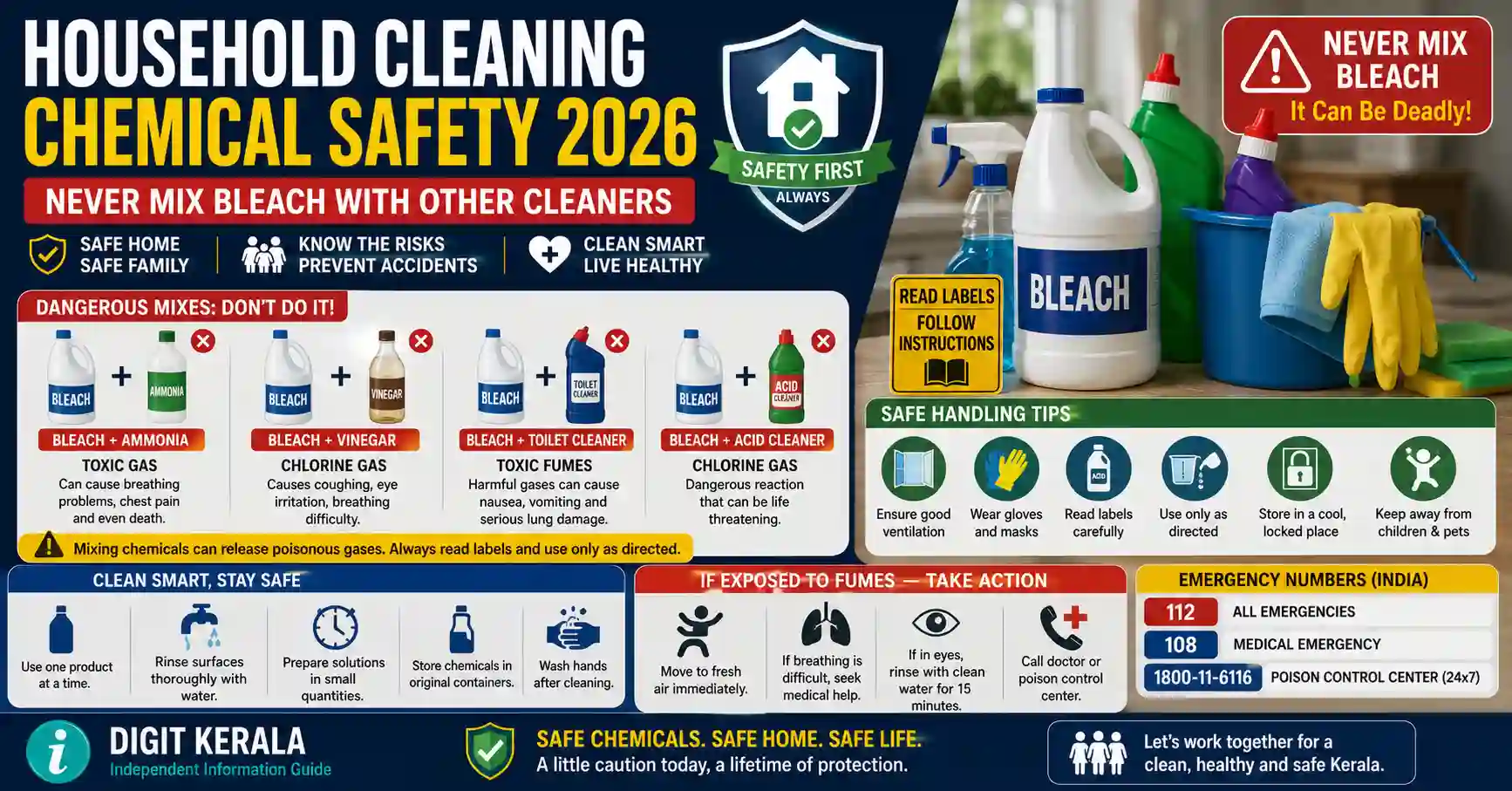
Household cleaners help remove dirt and maintain hygiene, but using them incorrectly can cause serious injuries. Mixing bleach with toilet cleaner, acid, ammonia or another disinfectant may release dangerous gases. Cleaning products may also cause poisoning, breathing difficulty, burns or eye injuries when swallowed, inhaled or splashed.
Many household chemical incidents can be prevented by following product labels, keeping rooms ventilated, storing products securely and never combining different cleaners.
This guide explains how to use cleaning chemicals safely, which products should never be mixed and what to do when accidental exposure occurs.
Emergency warning: If someone has difficulty breathing, collapses, becomes confused, has a seizure or suffers a serious chemical burn, move to a safe location and call 112 immediately. The AIIMS National Poisons Information Centre can be contacted at 1800 116 117 for poison-related guidance.
Why Mixing Cleaning Products Is Dangerous
A stronger smell or more foam does not mean a surface is being cleaned more effectively.
Different cleaning products can contain chemicals that react when combined. The reaction may produce toxic vapours, heat or splashes.
The Centers for Disease Control and Prevention advises people never to mix household bleach or disinfectants with other cleaners because the resulting vapours may be dangerous to breathe.
The safest rule is simple:
Use only one cleaning product at a time and follow its original label.
Do not create homemade chemical mixtures based on social-media videos or forwarded messages.
Cleaning and Disinfecting Are Different
Cleaning normally uses soap or detergent, water and physical scrubbing to remove dirt and many germs from a surface.
Disinfecting uses an appropriate chemical product to kill certain remaining germs.
According to the CDC, ordinary cleaning with soap and water is sufficient in many household situations. Additional disinfection may be appropriate in particular circumstances, such as when someone in the home is ill, but it should be performed according to the product instructions.
Using several chemicals together does not provide extra protection.
Never Mix Bleach With Other Cleaning Products
Bleach products may contain sodium hypochlorite. They should not be mixed with another cleaner or disinfectant.
Bleach and Acid-Based Toilet Cleaner
Many toilet and bathroom cleaners contain acids. Combining an acid-based product with bleach can release chlorine gas.
Exposure may cause:
- Burning in the eyes, nose or throat.
- Coughing.
- Chest tightness.
- Shortness of breath.
- Nausea or vomiting.
- Eye watering or blurred vision.
- Skin irritation.
- Serious breathing problems.
Never pour bleach into a toilet, sink, drain or bucket that still contains an acid-based cleaner.
Bleach and Ammonia
Some glass, floor and multipurpose cleaners may contain ammonia. Mixing ammonia with bleach can produce hazardous gases called chloramines.
Do not assume that a product is safe to combine because it has a mild smell or familiar brand name. Read the ingredient and warning information on the label.
Bleach and Vinegar
Vinegar is acidic. It should never be mixed with bleach.
The fact that vinegar is used in food does not make it safe to combine with household chemicals.
Bleach and Disinfectants
Do not combine bleach with:
- Toilet cleaner.
- Floor cleaner.
- Glass cleaner.
- Drain cleaner.
- Descaling product.
- Disinfectant liquid.
- Alcohol-based cleaning product.
- Hydrogen-peroxide product.
- Ammonia-containing product.
- Vinegar or another acid.
Even if a product’s ingredients are unclear, do not mix it with bleach.
Two Different Drain Cleaners
Different drain-cleaning products can contain incompatible chemicals. Combining them may create heat, splashing or hazardous fumes.
Use only one product and follow its label. Do not add another cleaner when the first one does not immediately clear the blockage.
Warning Signs of Chemical-Fume Exposure
Symptoms depend on the chemical, amount, ventilation, duration of exposure and the person’s existing health conditions.
Possible warning signs include:
- Burning eyes.
- Excessive tearing.
- Burning in the nose or throat.
- Persistent coughing.
- Wheezing.
- Chest tightness.
- Shortness of breath.
- Rapid or difficult breathing.
- Dizziness.
- Headache.
- Nausea or vomiting.
- Confusion.
- Unusual weakness.
- Skin redness, pain or blisters.
People with asthma or another lung condition may be more sensitive to irritating fumes.
Some symptoms can develop or worsen after leaving the area. Obtain medical advice after a significant exposure even if the person initially feels better.
What to Do If Cleaning Chemicals Are Accidentally Mixed
If strong fumes appear after two products are combined:
- Stop using the products immediately.
- Do not lean over the bucket, toilet, drain or container.
- Warn everyone nearby.
- Leave the room or building and move to fresh air.
- Keep children, older people and pets away.
- Call 112 if anyone has breathing difficulty or another serious symptom.
- Contact the AIIMS National Poisons Information Centre at 1800 116 117 for guidance.
- Follow instructions from emergency personnel or a qualified medical professional.
If the incident occurred indoors, do not remain inside merely to open every window. Personal safety comes first.
If doors or windows can be opened without entering or remaining in the contaminated area, ventilation may help. Do not re-enter until it is considered safe.
Do not switch on an exhaust fan, appliance or electrical equipment when a chemical is flammable or the risk is unknown.
Do Not Try to Neutralise the Mixture
Do not add vinegar, baking soda, detergent, water or another substance in an attempt to neutralise an unknown chemical mixture.
Adding another material could create a second reaction or cause splashing.
Do not smell the container to identify the product.
Do not attempt to clean a major spill without proper instructions, ventilation and protective equipment.
What to Do If Chemicals Enter the Eyes
If a cleaning chemical splashes into the eyes:
- Move away from the chemical source.
- Remove contact lenses when this can be done easily.
- Rinse the affected eyes gently with plenty of clean, lukewarm water.
- Continue rinsing for at least 10 to 15 minutes.
- Do not rub the eyes.
- Do not use eye drops, oils or home remedies unless directed by a medical professional.
- Obtain urgent medical advice, particularly if pain, redness or blurred vision continues.
Keep the chemical container or a clear photograph of its label available for healthcare professionals, but do not delay rinsing to find it.
What to Do After Skin Exposure
If a chemical spills on the skin:
- Move away from the source.
- Remove contaminated clothing and jewellery carefully.
- Avoid pulling contaminated clothing across the face.
- Rinse the skin with plenty of clean, lukewarm water.
- Do not scrub irritated or burned skin.
- Do not apply vinegar, baking soda, toothpaste, oil or another chemical.
- Obtain medical care for persistent pain, redness, swelling or blistering.
Anyone assisting should avoid direct contact with the chemical and contaminated clothing.
What to Do If a Cleaning Product Is Swallowed
Accidental swallowing requires immediate expert guidance.
- Do not force the person to vomit.
- Do not give salt water.
- Do not give vinegar, lemon juice, baking soda or another neutralising substance.
- Do not give food, milk or medicine unless instructed by a healthcare professional or poison-information specialist.
- Remove any remaining product from the mouth when this can be done safely.
- Contact the National Poisons Information Centre or go to the nearest appropriate healthcare facility.
- Call 112 if the person is unconscious, having a seizure, choking or experiencing breathing difficulty.
Do not give anything by mouth to an unconscious or drowsy person.
Take the original product container or label to the healthcare facility when it is safe to do so. Never transport an open or leaking container inside a vehicle.
AIIMS National Poisons Information Centre
The National Poisons Information Centre operates through the Department of Pharmacology at AIIMS New Delhi.
The official AIIMS page advises people not to wait for a poisoning victim to become visibly ill and not to attempt treatment without proper guidance.
AIIMS National Poisons Information Centre:
- Toll-free number: 1800 116 117
- Availability stated by AIIMS: 24 hours a day
- Emergency number: 112
Save these numbers on a phone and display them where household members can find them.
Helpline availability and telephone details can change. Verify the latest information on the official AIIMS website.
How to Use Household Cleaners Safely
Read the Entire Label
Before using a product, check:
- Intended use.
- Dilution instructions.
- Required ventilation.
- Surface restrictions.
- Protective-equipment instructions.
- First-aid information.
- Storage warnings.
- Expiry information.
- Products or chemicals that must not be combined.
Do not use a product when the label is missing or unreadable.
Use the Recommended Quantity
Using more than the label recommends may increase exposure without improving cleaning.
Never estimate a concentration when exact dilution is required. Follow the instructions for that specific product because chemical strengths can differ between brands.
Keep the Area Ventilated
When the label requires ventilation:
- Open suitable doors or windows.
- Avoid using strong chemicals in a sealed bathroom.
- Take breaks in fresh air when necessary.
- Keep other people away from the cleaning area.
A face covering intended for dust or infection control may not protect against chemical gases. Do not depend on an ordinary cloth or surgical mask when dangerous fumes are present.
Use Appropriate Protective Equipment
Follow the label regarding gloves, eye protection and other equipment.
Replace damaged gloves. Wash hands after removing them.
Do not touch the face, prepare food or handle children while wearing contaminated gloves.
Use One Product at a Time
Completely finish the permitted cleaning process and rinse the surface when the label requires it before considering a different product.
Do not pour chemicals into the same bucket or spray bottle.
Avoid Spraying Near the Face
When possible, apply a product in the manner recommended on its label.
Avoid creating unnecessary mist in a small enclosed area. Never spray a chemical towards another person, pet, food or electrical appliance.
Safe Chemical Storage at Home
Cleaning chemicals should be:
- Kept in their original labelled containers.
- Closed securely after use.
- Stored away from children and pets.
- Kept separately from food, medicine and drinking water.
- Stored away from heat, flames and direct sunlight when instructed.
- Placed upright to prevent leakage.
- Kept in a locked or child-resistant cupboard when possible.
- Stored according to temperature and ventilation instructions.
Never transfer a chemical into:
- A drinking-water bottle.
- A soft-drink bottle.
- A juice container.
- A food jar.
- A cooking vessel.
- An unlabelled spray bottle.
Someone may mistake the chemical for a drink or food ingredient.
Safety Around Children
Children may be attracted by colourful liquids, interesting containers or pleasant fragrances.
To reduce accidental exposure:
- Store chemicals above a child’s reach and preferably in a locked cupboard.
- Do not leave an open bucket unattended.
- Close products immediately after use.
- Never ask a young child to mix or dilute chemicals.
- Do not call chemicals “juice,” “medicine” or “sweets.”
- Keep handbags containing hand sanitiser or medicine away from children.
- Dispose of empty containers according to label and local instructions.
- Teach older children not to touch or smell unknown products.
Child-resistant caps reduce risk but are not completely childproof.
Safety for Cleaning Workers
Domestic workers, hotel staff, hospital cleaners, sanitation workers and other employees may face repeated chemical exposure.
Employers and supervisors should provide:
- Clearly labelled products.
- Instructions in a language workers understand.
- Training about incompatible chemicals.
- Adequate ventilation.
- Suitable gloves and eye protection when required.
- Safe dilution equipment.
- Access to washing facilities.
- A procedure for reporting spills and symptoms.
- Emergency-contact information.
Chemicals should never be mixed merely because a supervisor or coworker says the combination cleans faster.
Workers experiencing cough, wheezing, eye irritation, skin problems or repeated breathing symptoms should report the exposure and obtain appropriate medical assessment.
Safe Disposal of Cleaning Products
Do not pour leftover chemicals together before disposal.
Follow:
- The product label.
- Manufacturer instructions.
- Local-body waste rules.
- Directions from authorised waste-management services.
Keep leaking containers away from children, pets, food and drains while obtaining disposal guidance.
Never burn chemical containers. Do not reuse an empty chemical container for water, food, cooking oil or another household purpose.
Common Chemical-Safety Mistakes
Avoid these common mistakes:
- Mixing bleach and toilet cleaner.
- Mixing bleach and vinegar.
- Mixing bleach and ammonia.
- Combining two drain cleaners.
- Using several disinfectants simultaneously.
- Cleaning a small bathroom with the door closed.
- Using more chemical than recommended.
- Smelling an unlabelled bottle to identify it.
- Storing acid in a drinking-water bottle.
- Leaving products accessible to children.
- Using chemicals without reading the label.
- Applying unverified first-aid remedies after exposure.
- Returning to a room while strong fumes remain.
- Ignoring symptoms because the exposure was brief.
A Simple Home Chemical-Safety Checklist
Review this checklist regularly:
- Are all products in their original containers?
- Are labels readable?
- Are lids closed tightly?
- Are chemicals stored away from food and medicine?
- Can children or pets reach them?
- Are bleach and acid-based cleaners stored separately?
- Does everyone know never to mix cleaning products?
- Is ventilation available in cleaning areas?
- Are suitable gloves available when required?
- Are expired or leaking containers handled safely?
- Are emergency and poison-information numbers saved?
- Do household workers understand the safety instructions?
Correct any problem before the next cleaning session.
Frequently Asked Questions
Can bleach be mixed with toilet cleaner?
No. Toilet cleaners may contain acids that can react with bleach and release dangerous chlorine gas.
Can bleach be mixed with vinegar?
No. Vinegar is acidic and should never be mixed with bleach.
Is it safe to combine two disinfectants?
Do not combine disinfectants unless the product manufacturer has explicitly authorised that exact use. The safest general rule is to use one product at a time according to its label.
What should I do if strong fumes appear while cleaning?
Stop immediately, leave the area and move to fresh air. Keep others away and obtain emergency or poison-information guidance.
Should I induce vomiting if someone drinks a cleaning product?
No. Do not force vomiting. Contact the National Poisons Information Centre or a healthcare facility immediately.
Can I identify a chemical by smelling it?
No. Smelling an unknown chemical may expose the nose, throat and lungs to harmful vapours.
Does an ordinary face mask protect against chemical gas?
An ordinary cloth or surgical mask should not be relied upon for protection from hazardous chemical gases. Leave the contaminated area and obtain professional guidance.
What number can I call for poisoning guidance in India?
The AIIMS National Poisons Information Centre lists the toll-free number 1800 116 117. Call 112 for an immediate emergency.
Official References
- AIIMS National Poisons Information Centre
- AIIMS Poison Information Centre Contact Details
- CDC – Cleaning and Disinfecting With Bleach
- CDC – Chlorine Chemical Emergency Guidance
- World Health Organization – Chemical Safety
Last reviewed: August 30, 2026.
Disclaimer: DIGIT KERALA is an independent information website and is not affiliated with AIIMS, the National Poisons Information Centre, the World Health Organization, the CDC or any government agency. This article provides general safety information and does not replace instructions on a product label, poison-centre guidance or professional medical care. Chemical ingredients, risks and emergency responses vary. During a suspected poisoning or serious exposure, contact qualified emergency services or a poison-information centre without delay.