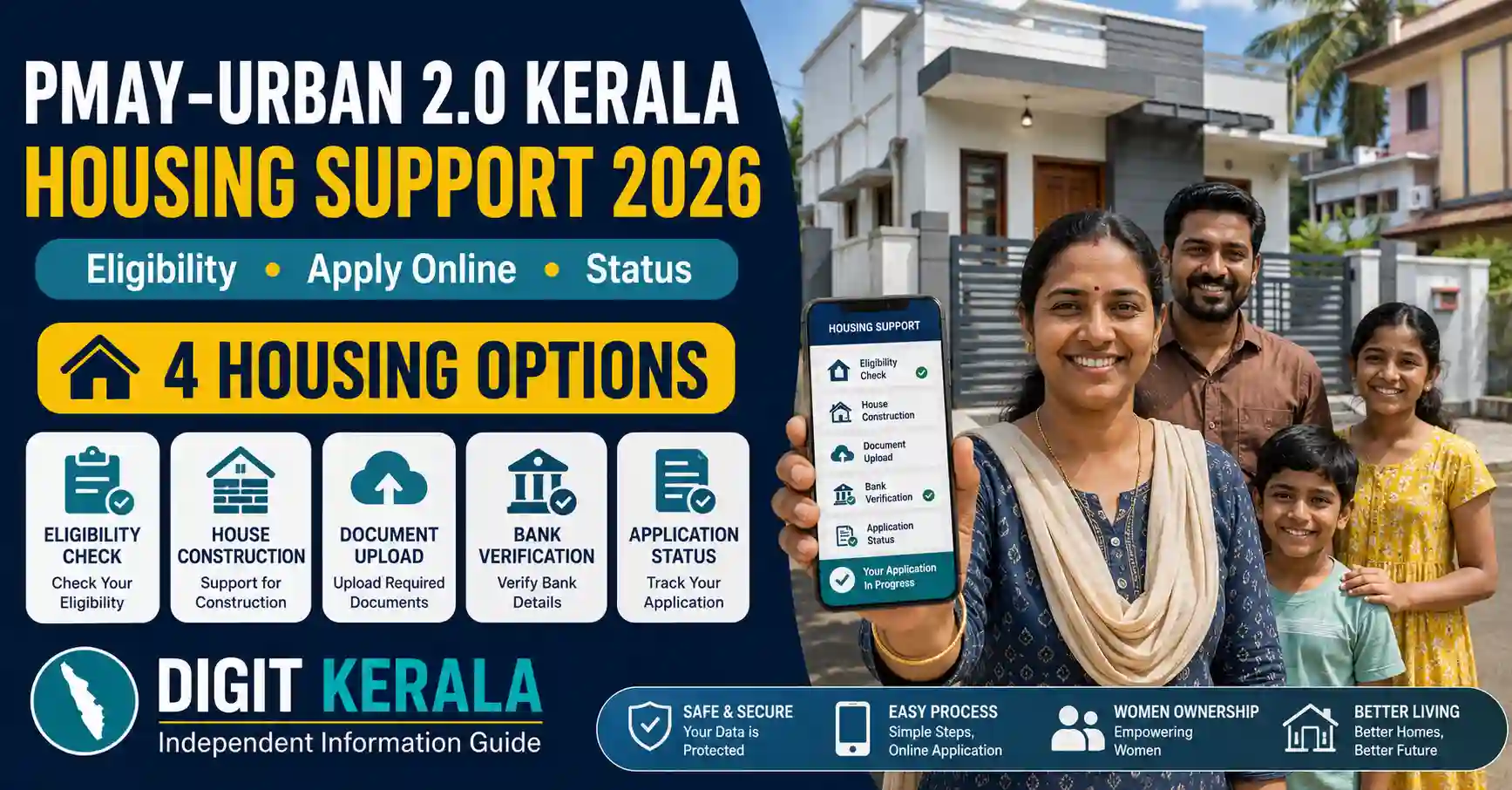
Pradhan Mantri Awas Yojana–Urban 2.0 provides housing assistance to eligible urban families who do not own a permanent house anywhere in India.
Kerala residents living within eligible municipal corporations, municipalities and other notified urban areas may apply through the official PMAY-U 2.0 portal, a Common Service Centre or the responsible Urban Local Body.
The scheme has four different components: Beneficiary Led Construction, Affordable Housing in Partnership, Affordable Rental Housing and the Interest Subsidy Scheme.
The benefit available to an applicant depends on the selected component, annual household income, land or home-loan information, property value and verification by the responsible authorities.
Important: Submitting an application does not guarantee a house, cash payment, home loan or subsidy. Eligibility and final approval are determined only after official verification.
What Is PMAY-Urban 2.0?
PMAY-Urban 2.0 is a Central Government housing scheme implemented by the Ministry of Housing and Urban Affairs.
It is intended to help eligible Economically Weaker Section, Lower Income Group and Middle Income Group families living in urban areas construct, purchase or rent an affordable house.
Depending on the applicant’s circumstances, assistance may be available through one of the following verticals:
- Beneficiary Led Construction.
- Affordable Housing in Partnership.
- Affordable Rental Housing.
- Interest Subsidy Scheme.
A family can receive assistance through only one applicable vertical.
PMAY-Urban and PMAY-Gramin Are Different
Applicants should identify whether their residence or proposed house comes under an urban or rural local authority.
PMAY-Urban 2.0
PMAY-U 2.0 applies to eligible families living within:
- Municipal corporations.
- Municipalities.
- Statutory towns.
- Subsequently notified towns.
- Certain notified planning, development, industrial or special-area authorities.
PMAY-Gramin
PMAY-G is intended for eligible rural households.
A postal address containing the name of a village does not automatically determine the applicable scheme. Confirm whether the property comes under a municipality, corporation or grama panchayat.
The responsible local body can clarify which scheme applies.
PMAY-U 2.0 Income Limits
The household’s annual income category is important when determining eligibility.
| Income category | Annual household income |
|---|---|
| Economically Weaker Section – EWS | Up to ₹3 lakh |
| Lower Income Group – LIG | More than ₹3 lakh and up to ₹6 lakh |
| Middle Income Group – MIG | More than ₹6 lakh and up to ₹9 lakh |
These are household-income limits, not the income of only one family member.
Applicants should provide truthful and verifiable income information. The authority or lending institution may request an income certificate, salary records, bank information or another accepted document.
Basic Eligibility Conditions
An applicant generally needs to satisfy the following conditions:
- The applicant must be an Indian citizen.
- The family must live in an eligible urban area.
- The family’s annual household income must fall within the applicable limit.
- The applicant or another member of the beneficiary family must not own a pucca house anywhere in India.
- The family must not have received a housing benefit from a Central, State, Union Territory or Local Government housing scheme during the preceding 20 years.
- The applicant must meet the conditions of the selected PMAY-U 2.0 vertical.
- Aadhaar and other requested information must pass verification.
- The proposed house, project or home loan must satisfy the applicable scheme conditions.
A vacant plot owned by a family member does not by itself mean that the family owns a pucca house. The land may be relevant when applying under Beneficiary Led Construction.
What Is a Beneficiary Family?
For the scheme, a beneficiary family generally includes:
- Husband.
- Wife.
- Unmarried sons.
- Unmarried daughters.
The scheme benefit is provided to the eligible household rather than separately to every individual family member.
A married couple can receive assistance for only one house. The house may be held in the name of the eligible woman or jointly in the names permitted under the scheme.
Information regarding parents and dependent family members may also be requested during the application or home-loan verification process.
What Is a Pucca House?
A pucca house is generally an all-weather dwelling constructed using durable materials for the walls and roof.
Applicants are required to declare that the beneficiary family does not own such a house anywhere in India.
Providing a false declaration can lead to rejection, recovery of assistance or further action under the applicable rules.
Four Components of PMAY-U 2.0
Applicants should understand the four verticals before choosing one.
1. Beneficiary Led Construction
Beneficiary Led Construction, or BLC, is intended for eligible EWS families who have their own available land and want to construct a new pucca house.
The applicant must provide valid land-ownership documents.
The proposed house should generally have a carpet area between 30 and 45 square metres and comply with the applicable building, safety and local-authority requirements.
Construction progress may be geo-tagged and inspected. Assistance is released according to approved stages of construction.
BLC should not be selected merely for routine repairs or decoration of an existing pucca house.
2. Affordable Housing in Partnership
Affordable Housing in Partnership, or AHP, supports eligible EWS beneficiaries purchasing a house in an approved affordable-housing project.
Projects may be developed by:
- Public-sector agencies.
- Government bodies or parastatal agencies.
- Eligible private-sector developers under the scheme conditions.
The beneficiary must pay the remaining approved cost after the applicable government assistance.
Before making a payment, verify that the project and beneficiary unit are officially covered under PMAY-U 2.0. A private builder merely using the words “PMAY eligible” does not prove approval.
3. Affordable Rental Housing
Affordable Rental Housing, or ARH, is intended to improve access to affordable rental accommodation for eligible EWS and LIG beneficiaries.
It may be useful for groups such as:
- Urban migrants.
- Industrial workers.
- Construction workers.
- Street vendors.
- Service-sector workers.
- Students and other eligible urban residents.
ARH is a rental-housing component. It should not be described as a free-house or home-ownership grant.
Rent, security deposit, tenancy conditions and availability depend on the approved project and implementing agency.
4. Interest Subsidy Scheme
The Interest Subsidy Scheme, or ISS, provides an eligible home-loan subsidy to EWS, LIG and MIG families.
The official conditions include:
- Annual household income not exceeding ₹9 lakh.
- Eligible home loan sanctioned and disbursed on or after September 1, 2024.
- Home-loan amount not exceeding ₹25 lakh.
- Property value not exceeding ₹35 lakh.
- Carpet area not exceeding 120 square metres.
- Compliance with the no-pucca-house and previous-housing-benefit conditions.
The maximum permissible subsidy is ₹1.80 lakh. The actual amount depends on the eligible loan amount, tenure and other scheme conditions.
The subsidy is credited through the home-loan account according to the applicable release mechanism. It is not handed to the borrower as unrestricted advance cash.
The scheme does not guarantee that a bank will approve a home loan. The lending institution separately checks income, repayment capacity, credit history, documents and property information.
PMAY-U 2.0 Assistance in Kerala
Kerala comes under the “all other States” funding category in the official PMAY-U 2.0 guidelines.
For an approved BLC or AHP unit, the funding pattern is:
| Contribution | Amount per approved unit |
|---|---|
| Central Government assistance | ₹1.50 lakh |
| Minimum State Government share | ₹1 lakh |
| Total government share under the funding pattern | ₹2.50 lakh |
This does not mean that every person submitting an application receives ₹2.50 lakh.
The assistance applies only to an eligible and approved beneficiary or unit under the relevant BLC or AHP process. The beneficiary is responsible for meeting the remaining house or construction cost.
Under BLC, the Central assistance is released through the approved DBT and construction-progress mechanism. The official FAQ describes a 40:40:20 release pattern for the Central share.
The ISS component follows a different system and provides an eligible interest subsidy of up to ₹1.80 lakh through the home-loan account.
ARH is a rental-housing component and does not provide the same direct ownership assistance.
Always verify the amount, State contribution and current implementation procedure through the official portal or local authority before making a financial commitment.
Preference Groups Under the Scheme
Subject to eligibility, preference may be given to vulnerable groups such as:
- Widows and single women.
- Persons with disabilities.
- Senior citizens.
- Transgender persons.
- Scheduled Caste and Scheduled Tribe families.
- Minorities.
- Other weaker and vulnerable sections.
- Safai Karmis.
- Street vendors registered under PM SVANidhi.
- Artisans registered under PM Vishwakarma.
- Anganwadi workers.
- Building and construction workers.
- Residents of eligible slums.
Being part of a preference group does not remove the ordinary eligibility and verification requirements.
Woman Ownership Requirement
A house constructed, acquired or purchased using PMAY-U 2.0 Central assistance should generally be:
- In the name of the adult female head of the household; or
- Jointly in the names of the male head and his wife.
If there is no adult female member in the family, the property may be registered in the eligible male member’s name according to the scheme conditions.
Special provisions apply to widowers, unmarried persons, separated persons and transgender applicants.
Applicants should confirm the required ownership structure before registering or purchasing the property.
Documents Required
The exact documents depend on the selected vertical and local verification process.
Common documents may include:
- Aadhaar card of the applicant.
- Aadhaar information of family members.
- Recent photograph.
- Active mobile number linked with Aadhaar.
- PAN card, voter ID or another accepted identity document.
- Address proof.
- Income certificate or accepted income evidence.
- Bank-account details.
- Bank passbook or cancelled cheque.
- Family and marital-status information.
- Undertaking that the family does not own a pucca house.
- Declaration regarding previous government housing benefits.
- Caste, disability or priority-category proof when applicable.
Additional Documents for BLC
BLC applicants may need:
- Land-ownership document.
- Latest land-tax receipt.
- Possession or location information.
- Approved building plan or permit when required.
- Property-related certificates requested by the local body.
- Construction-cost or technical information.
Additional Information for ISS
ISS applicants may need:
- PAN card.
- Home-loan account information.
- Name and details of the Primary Lending Institution.
- Loan-sanction and disbursement information.
- Property value and carpet-area information.
- Sale agreement or construction documents.
- Additional documents requested by the lender.
Upload only clear and complete copies. The name on Aadhaar should match the information entered during Aadhaar authentication.
How to Apply Online
Follow these general steps:
- Visit the official PMAY-U 2.0 portal.
- Select Apply for PMAY-U 2.0.
- Read the scheme instructions and privacy information.
- Complete the preliminary eligibility check.
- Enter the State, urban local body, income and housing information.
- Select the appropriate scheme vertical carefully.
- Provide Aadhaar consent and complete OTP authentication.
- Enter the applicant’s personal and family details.
- Provide present-address and contact information.
- Enter household-income information.
- Provide bank-account details.
- Enter land, project or home-loan information as applicable.
- Upload or provide the requested declarations and documents.
- Review every entry before submission.
- Submit the application.
- Save the application ID, acknowledgement or user code.
Portal fields and verification procedures may change. Follow the latest instructions displayed on the official website.
Do not submit multiple applications using different family members’ Aadhaar numbers to obtain more than one benefit.
Choose the Correct Vertical Carefully
The selected vertical determines the documents, verification and type of assistance.
Before submitting, check whether the family:
- Owns vacant land and wants to construct a house.
- Wants to purchase a unit in an approved AHP project.
- Needs affordable rental accommodation.
- Has taken or plans to take an eligible home loan.
Changing the vertical can be restricted after submission or after a loan has been processed. Seek clarification from the municipality or responsible authority before selecting an option if uncertain.
Applying Through a Municipality or CSC
Applicants who cannot complete the online application independently may approach:
- The responsible municipal corporation.
- Municipality office.
- Urban Local Body help desk.
- Authorised Common Service Centre.
Carry original documents and clear copies.
If a CSC charges a permitted service fee, obtain a receipt. A CSC operator or private agent cannot guarantee approval.
Never hand over original Aadhaar, land documents, blank signed papers, bank passwords or verification codes to an unauthorised person.
What Happens After Submission?
Submitting the form creates an application for verification.
The responsible authority may check:
- Aadhaar and identity information.
- Beneficiary-family details.
- Annual household income.
- Current address and urban jurisdiction.
- Ownership of a pucca house.
- Previous housing-scheme benefits.
- Land ownership for BLC.
- Approved-project information for AHP.
- Home-loan and property information for ISS.
- Bank-account information.
- Priority-category information.
Local verification, document correction, site inspection or additional clarification may be required.
BLC applications also need project preparation and approval through the applicable State and Central sanction process.
Construction Monitoring and Geo-Tagging
For approved BLC houses, construction progress may be recorded using geo-tagged photographs.
The local authority may verify stages such as:
- Existing site condition.
- Foundation or plinth stage.
- Wall and roof progress.
- House completion.
The applicable instalment is linked to verified construction progress.
Applicants should not upload photographs of another property or provide incorrect location information. Such activity can lead to rejection or recovery proceedings.
How to Check Application Status
Applicants can use the official PMAY-U 2.0 portal to check the available application information.
The portal may request:
- Application ID.
- Unique user code.
- Registered mobile number.
- Aadhaar-based verification.
- Another application reference.
Possible stages may include submitted, under scrutiny, pending verification, approved, rejected or assistance released.
The wording can vary according to the selected vertical and processing authority.
A submitted or verified status should not be treated as final approval unless the competent authority has approved the beneficiary and applicable assistance.
Common Reasons for Delay or Rejection
An application may be delayed or rejected because of:
- Family ownership of a pucca house.
- Previous benefit from another government housing scheme.
- Household income above the applicable limit.
- Property outside the eligible urban jurisdiction.
- Incorrect scheme vertical.
- Aadhaar-name or date-of-birth mismatch.
- Duplicate family application.
- Invalid land-ownership documents.
- Land dispute or unclear title.
- Missing income evidence.
- Incorrect bank-account details.
- Home loan or property value above ISS limits.
- Loan sanctioned before the applicable ISS date.
- Unapproved housing project.
- Unreadable documents.
- False or incomplete declaration.
- Failure to respond to verification requests.
Correct an application only through the official procedure. Do not pay an intermediary claiming that a rejected application can be secretly approved.
Can the House Be Sold or Rented Immediately?
PMAY-U 2.0 contains restrictions intended to prevent misuse of assisted houses.
An assisted house generally cannot be sold, transferred, subleased or rented out during the applicable five-year lock-in period after completion.
Specific conditions depend on the vertical and property documents.
ISS applicants should also check the consequences of transferring the property or changing the loan during the subsidy period.
Obtain official clarification before selling or transferring an assisted property.
Fraud-Prevention Tips
Housing-scheme applications involve sensitive identity, banking and property information.
Follow these precautions:
- Use only the official PMAY-U 2.0 website.
- Check that the domain ends in
gov.in. - Never share Aadhaar OTPs or bank verification codes.
- Do not pay anyone promising guaranteed approval.
- Obtain receipts for authorised payments.
- Do not sign blank application or property documents.
- Verify AHP project approval independently.
- Do not make a builder payment based only on an advertisement.
- Keep the application acknowledgement safely.
- Do not upload Aadhaar or land documents through unknown WhatsApp links.
- Report suspicious demands to the responsible municipality or authority.
No private website, agent, builder or bank employee can guarantee PMAY-U 2.0 approval.
Frequently Asked Questions
Who can apply for PMAY-U 2.0 in Kerala?
Eligible Indian families living within a covered urban area may apply if their annual household income is within the applicable limit, they do not own a pucca house anywhere in India and they meet the other scheme conditions.
Is ₹2.50 lakh available to every applicant?
No. Under the BLC and AHP funding pattern applicable to Kerala, an approved unit has a Central share of ₹1.50 lakh and a minimum State share of ₹1 lakh. Eligibility, project sanction, verification and beneficiary contribution are required.
Can a person who owns land apply?
Owning a vacant plot does not automatically disqualify an applicant. An eligible EWS family with suitable land may be considered under BLC after land and project verification.
Can a person who owns a house in another district apply?
The beneficiary family must not own a pucca house anywhere in India. Ownership in another district or State can affect eligibility.
Can rural residents apply through PMAY-U 2.0?
PMAY-U 2.0 is for covered urban areas. Residents under a rural local authority should check the applicable PMAY-Gramin or State housing programme.
What is the maximum ISS subsidy?
The maximum permissible interest subsidy is ₹1.80 lakh. The actual amount depends on the eligible loan amount, tenure and scheme conditions.
Is an old home loan eligible for ISS?
The official cutoff requires the eligible loan to have been sanctioned and disbursed on or after September 1, 2024. A loan sanctioned before that date is not made eligible merely by revising it later.
Is the home-loan subsidy paid as cash?
No. The ISS subsidy is processed through the eligible home-loan account under the official release mechanism.
Does applying guarantee a bank loan?
No. Loan approval is a separate decision made by the lending institution after checking repayment capacity, documents, credit information and property eligibility.
Can an applicant use two PMAY-U 2.0 components?
No. An eligible beneficiary can receive assistance through only one applicable vertical.
Where can the application status be checked?
Use the official PMAY-U 2.0 unified portal and the application ID, user code or registered mobile information requested by the system.
Official References
- PMAY-Urban 2.0 Official Portal
- PMAY-U 2.0 Official FAQ
- PMAY-U 2.0 Eligibility Check
- PMAY-U 2.0 Online Application
- PMAY-U 2.0 Operational Guidelines
- Ministry of Housing and Urban Affairs
Last reviewed: August 27, 2026.
Disclaimer: DIGIT KERALA is an independent information website and is not affiliated with the Ministry of Housing and Urban Affairs, PMAY-U, Kerala Government, any municipality, bank, builder or housing agency. This article is provided for general informational purposes only. Eligibility, assistance, State contribution, loan conditions, application procedures and portal features may change. Application, home-loan approval and scheme assistance are not guaranteed. Always verify the latest information through the official PMAY-U 2.0 portal and the responsible local authority.