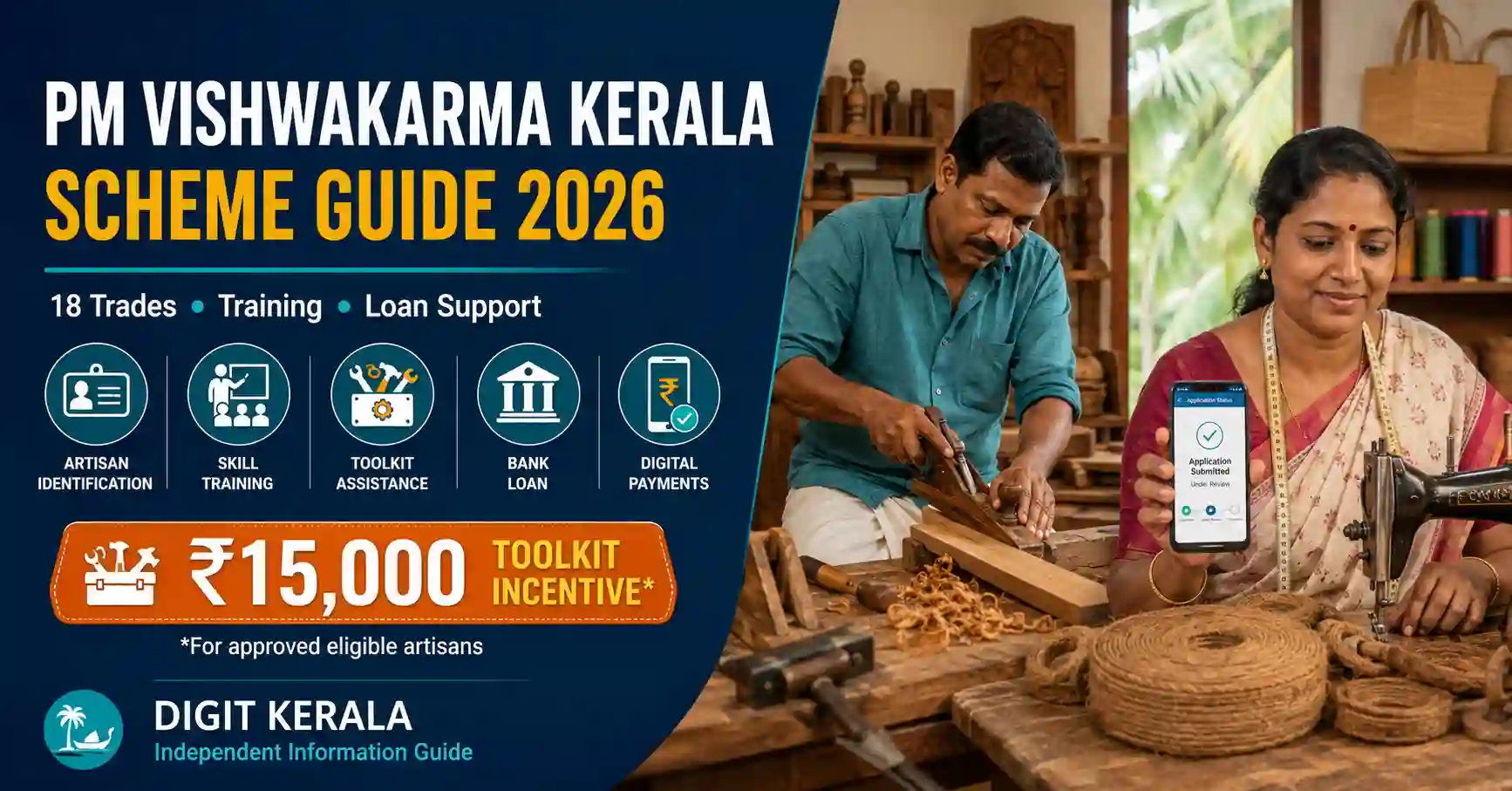
PM Vishwakarma is a Central Government scheme providing recognition, skill training, toolkit support, concessional enterprise loans, digital-transaction incentives and marketing assistance to eligible traditional artisans and craftspeople.
Eligible Kerala artisans working in one of the 18 notified family-based traditional trades can register through an authorised Common Service Centre using Aadhaar-based biometric authentication.
The scheme provides a toolkit incentive of up to ₹15,000 and collateral-free enterprise-development loans of up to ₹3 lakh in two stages. However, the toolkit benefit is provided through the prescribed e-voucher process, and the loan must be repaid.
Important: Registration does not guarantee approval, a toolkit incentive, training admission or a loan. Every application is subject to local-body verification, committee approval, training requirements and lender assessment.
What Is the PM Vishwakarma Scheme?
PM Vishwakarma is implemented by the Ministry of Micro, Small and Medium Enterprises.
The scheme is intended to support artisans and craftspeople who work mainly with their hands and traditional tools in the unorganised or self-employed sector.
The main objectives are:
- Official recognition of traditional artisans.
- Improvement of practical and business skills.
- Access to modern tools.
- Affordable collateral-free business credit.
- Promotion of digital payments.
- Branding, quality certification and market linkage.
- Support for connecting artisans with new customers.
After successful registration and verification, an approved beneficiary may receive a PM Vishwakarma Certificate and ID Card.
PM Vishwakarma Benefits
The scheme combines several forms of support. They are not all automatic cash benefits.
| Scheme component | Applicable support |
|---|---|
| Recognition | PM Vishwakarma Certificate and ID Card |
| Basic training | Generally 5–7 days or 40 hours |
| Advanced training | Generally 15 days or 120 hours |
| Training stipend | ₹500 per eligible training day |
| Toolkit incentive | Up to ₹15,000 through the prescribed e-voucher process |
| First loan stage | Up to ₹1 lakh |
| Second loan stage | Up to ₹2 lakh |
| Beneficiary interest rate | 5%, subject to scheme conditions |
| Digital-payment incentive | ₹1 per eligible transaction, up to 100 transactions per month |
| Marketing support | Branding, certification, e-commerce and promotional assistance |
The maximum value mentioned under a component should not be treated as a guaranteed payment.
Who Can Apply in Kerala?
An applicant generally needs to satisfy the following conditions:
- The applicant must be at least 18 years old on the registration date.
- The applicant must work with hands and tools.
- The applicant must currently be engaged in one of the 18 eligible traditional trades.
- The work must generally be undertaken in the unorganised sector on a self-employment basis.
- Only one member of a family can receive registration and benefits.
- The applicant and family members must not be employed in government service.
- The applicant must satisfy the restrictions concerning previous government business loans.
- Aadhaar-based biometric authentication must be completed.
- The application must pass the required local and committee verification.
The scheme is available in rural and urban areas. In Kerala, the first-stage verification is handled through the relevant grama panchayat or Urban Local Body, depending on the applicant’s address.
Meaning of Family Under the Scheme
For PM Vishwakarma, a family generally consists of:
- Husband.
- Wife.
- Unmarried children.
Only one eligible person from this family can receive registration and benefits under the scheme.
Submitting separate applications in the names of the husband, wife and unmarried children may result in duplicate detection or rejection.
18 Eligible Traditional Trades
The scheme currently covers the following 18 trades.
Wood-Based Trades
- Carpenter.
- Boat Maker.
Iron, Metal and Stone-Based Trades
- Armourer.
- Blacksmith.
- Hammer and Tool Kit Maker.
- Locksmith.
- Sculptor, Stone Carver or Stone Breaker.
The metal category may also cover eligible traditional work involving bronze, brass, copper, lamps, utensils and figurines according to the scheme classification.
Gold and Silver-Based Trade
- Goldsmith.
Clay-Based Trade
- Potter.
Leather-Based Trade
- Cobbler, Shoesmith or Footwear Artisan.
Construction Trade
- Mason.
Other Eligible Trades
- Basket, Mat or Broom Maker and Coir Weaver.
- Traditional Doll and Toy Maker.
- Barber.
- Garland Maker.
- Washerman.
- Tailor.
- Fishing Net Maker.
The applicant must be genuinely engaged in the selected trade. Merely holding a certificate or having previously worked in the trade may not be sufficient if the applicant is not currently practising it.
Are All Tailors, Barbers and Masons Eligible?
The scheme is intended for traditional artisans and craftspeople working in the unorganised sector on a self-employment basis.
Eligibility is not based only on the name of the occupation.
The verification authority may check:
- Whether the applicant currently performs the trade.
- Whether the applicant works using hands and tools.
- Whether the work falls within the notified traditional-trade category.
- Whether the applicant is self-employed or part of the unorganised sector.
- Whether another family member has already registered.
- Whether the applicant satisfies the other scheme conditions.
Employees working in a large organised company may not automatically qualify merely because their job title is tailor, barber or mason.
PM Vishwakarma Certificate and ID Card
An applicant approved under the scheme receives recognition as a Vishwakarma through:
- PM Vishwakarma Certificate.
- PM Vishwakarma ID Card.
The certificate and card identify the beneficiary as an approved artisan under the scheme.
However, the certificate is not:
- A government employment appointment.
- A trade licence for every legal purpose.
- A guarantee of a business loan.
- Proof that every scheme benefit has already been released.
Each benefit has its own eligibility and processing stages.
Basic Skill Training
Approved beneficiaries undergo skill verification followed by basic training.
The basic programme generally lasts:
- Five to seven days; or
- Approximately 40 training hours.
Training may include:
- Improvement of existing trade skills.
- Use of modern tools.
- Product quality and standardisation.
- Workplace safety.
- Basic financial knowledge.
- Digital-payment awareness.
- Marketing and business-management knowledge.
Completing the basic training is normally important for accessing subsequent components such as the toolkit incentive and first loan stage.
Advanced Skill Training
Interested and eligible beneficiaries may also join advanced training.
The advanced programme generally lasts:
- 15 days; or
- Approximately 120 training hours.
Advanced training may cover higher-level trade techniques, modern production processes, product design, quality improvement and business development.
Availability depends on the trade, training centre, batch and official schedule.
Training Stipend
Eligible beneficiaries participating in approved skill training receive a stipend of ₹500 per training day.
The stipend is connected to actual participation in authorised training.
It should not be interpreted as:
- A permanent monthly pension.
- A salary from the government.
- An unemployment allowance.
- A payment available without attending training.
Attendance, bank verification and completion records may be checked before payment.
₹15,000 Toolkit Incentive
An eligible beneficiary may receive a toolkit incentive of up to ₹15,000.
The assistance is intended for purchasing tools relevant to the beneficiary’s approved trade.
The benefit is provided through the prescribed e-voucher or toolkit-procurement mechanism. It is not unrestricted cash that can be used for personal expenses.
The applicant may need to complete:
- Registration and approval.
- Skill assessment.
- Basic training.
- Aadhaar and bank verification.
- The current toolkit-selection procedure.
Tool availability and delivery methods can vary according to the trade and implementation arrangement.
Avoid agents offering to exchange a toolkit voucher for cash.
Enterprise-Development Loan
PM Vishwakarma provides access to collateral-free enterprise-development loans of up to ₹3 lakh in two stages.
These are repayable business loans and not government grants.
First Loan Stage
The first loan stage provides:
- Loan amount of up to ₹1 lakh.
- Repayment period of up to 18 months.
- Beneficiary interest rate of 5%, subject to the scheme conditions.
- No ordinary collateral requirement under the scheme.
Completing the applicable basic training is required before accessing the first loan stage.
Second Loan Stage
The second loan stage provides:
- Loan amount of up to ₹2 lakh.
- Repayment period of up to 30 months.
- Beneficiary interest rate of 5%, subject to the scheme conditions.
The second stage is not automatically released after receiving the first loan.
The beneficiary generally needs to:
- Have used the first loan stage.
- Maintain a standard loan account.
- Satisfy repayment requirements.
- Adopt digital transactions in the business or complete advanced training.
- Pass the lending institution’s verification.
The lending institution can reject or reduce a loan based on the scheme conditions, repayment capacity, banking information and application assessment.
Does Collateral-Free Mean the Loan Is Free?
No.
Collateral-free means the lender does not normally require the borrower to provide eligible property or another asset as security under the scheme mechanism.
The borrower must still:
- Repay the principal.
- Pay the applicable 5% beneficiary interest.
- Follow the repayment schedule.
- Use the loan for the approved enterprise purpose.
- Maintain the loan account properly.
Failure to repay can affect the borrower’s credit history and eligibility for the second loan stage or other loans.
Digital-Transaction Incentive
The scheme provides an incentive of ₹1 for each eligible digital transaction, subject to a maximum of 100 transactions per month.
The maximum monthly incentive under this limit is therefore ₹100.
Eligible transactions may include approved digital business receipts and payments recorded through the applicable system.
Transactions created only to obtain an incentive may be rejected. Applicants should use digital payments for genuine business activity.
Marketing Support
Eligible beneficiaries may receive marketing-related support through the scheme’s authorised mechanism.
Support may include:
- Product quality certification.
- Branding and promotion.
- Packaging-related guidance.
- E-commerce linkage.
- Trade-fair participation.
- Advertising and publicity.
- Connection with new markets.
Marketing support does not guarantee sales, customers, profit or e-commerce approval.
Previous Government Loan Restriction
An applicant should not have received a loan under a similar Central or State Government credit-based scheme for self-employment or business development during the preceding five years.
Examples can include:
- PM Employment Generation Programme.
- PM SVANidhi.
- MUDRA loans.
- Similar government-supported business credit schemes.
The guidelines provide specific treatment for fully repaid MUDRA and PM SVANidhi loans. Applicants with a previous loan should disclose it and ask the CSC or responsible authority to verify current eligibility.
Do not hide a previous loan. Aadhaar, bank and government-portal records may be checked.
Can Government Employees Apply?
A person employed in government service is not eligible.
The scheme also excludes the family members of a government employee according to its family definition.
Private-sector employment, casual work and self-employment are different situations, but the applicant must still prove genuine engagement in an eligible traditional trade within the intended sector.
Documents Required
Applicants should generally keep the following available:
- Aadhaar card.
- Aadhaar-linked mobile number.
- Bank-account details.
- Bank passbook.
- Ration card.
- Residential-address information.
- Family-member information.
- Details of the traditional trade.
- Information about previous government loans.
If a ration card is unavailable, Aadhaar information for the relevant family members may be requested according to the portal procedure.
Additional documents may be requested during:
- Grama panchayat or municipality verification.
- Training enrolment.
- Bank-loan processing.
- Toolkit delivery.
- Correction of applicant information.
PAN, income records or business-related documents may be requested by the lending institution when processing a loan.
Is Registration Free?
Registration under PM Vishwakarma through the authorised CSC process is free for the applicant.
The government bears the prescribed CSC registration cost.
An applicant may separately incur ordinary expenses for services such as photocopying or printing, but no person should charge a large “scheme registration fee” or demand a percentage of the expected benefit.
Always request a receipt for any permitted service charge.
How to Register Through a CSC
Applicant registration is carried out through an authorised Common Service Centre.
Follow these general steps:
- Locate an authorised CSC near the applicant’s residence.
- Carry the Aadhaar card, ration card, bank passbook and registered mobile.
- Inform the CSC operator that the application is for PM Vishwakarma.
- Select the correct traditional trade.
- Provide personal, family and address information.
- Disclose any previous government-supported business loan.
- Complete Aadhaar-based biometric authentication.
- Review the information entered by the CSC operator.
- Submit the registration.
- Obtain the application or registration reference.
- Wait for local-body and committee verification.
- Track future communication regarding approval, training and other benefits.
Do not allow the operator to select a different trade merely because it appears easier to approve.
Can Applicants Register Directly from Home?
The official process uses authorised CSC agents for initial artisan registration and Aadhaar-based biometric authentication.
The applicant or beneficiary login on the official portal can be used for supported post-registration services and checking information.
Avoid private websites that copy the scheme name and collect Aadhaar or bank information through a general online form.
Verification Process
Registration does not immediately make a person an approved beneficiary.
The application passes through a multi-stage verification process.
First-Stage Verification
The relevant authority verifies the applicant at the local level.
Depending on the location, this may involve:
- Grama panchayat verification.
- Municipality or Urban Local Body verification.
The authority checks whether the applicant is genuinely engaged in the selected trade.
District-Level Verification
The application may then be reviewed by the District Implementation Committee.
This stage can include checking records, eligibility and the first-stage recommendation.
Screening Committee Approval
The application is then considered through the prescribed Screening Committee process.
Only after successful verification and approval can the applicant proceed as an eligible beneficiary.
How to Check Application Status
Registered applicants can use the official PM Vishwakarma portal or obtain assistance from the CSC.
To check available information:
- Visit the official PM Vishwakarma portal.
- Select the applicant or beneficiary login.
- Enter the registered mobile number.
- Complete the requested verification.
- Review the application or beneficiary information displayed.
The portal may show whether the application is pending at the panchayat, Urban Local Body, district or another verification stage.
A pending status does not necessarily mean rejection. Verification time can vary.
Common Reasons for Delay or Rejection
Possible reasons include:
- Applicant not currently practising the selected trade.
- Occupation outside the notified 18 trades.
- Incorrect trade selected during registration.
- Aadhaar authentication failure.
- Name, address or family-information mismatch.
- Duplicate registration by another family member.
- Government employment of the applicant or family member.
- Previous ineligible government-supported loan.
- Unable to verify the applicant locally.
- Incorrect bank details.
- False declaration.
- Missing response to a verification request.
- Application pending before the responsible committee.
Do not submit duplicate registrations from multiple CSCs merely because the first application remains pending.
Correcting Application Information
If the Aadhaar name, mobile number, bank account, trade or family information is incorrect, contact the CSC or responsible authority.
Some Aadhaar information may need to be corrected through an authorised Aadhaar service before the scheme record can be updated.
Never create a second Aadhaar-based application solely to bypass an error in the first application.
Fraud-Prevention Tips
PM Vishwakarma applications contain sensitive personal and banking information.
Follow these precautions:
- Register only through an authorised CSC.
- Use only the official
pmvishwakarma.gov.inportal. - Never share bank OTPs, PINs or passwords.
- Do not pay agents promising guaranteed approval.
- Do not pay anyone to obtain a fake trade-verification certificate.
- Check all details before biometric authentication.
- Obtain the registration reference.
- Do not transfer toolkit e-vouchers to another person.
- Use loan funds only for the approved business purpose.
- Do not believe claims describing the ₹3 lakh loan as free money.
- Verify suspicious calls through the CSC or official authority.
No private agent can control local-body verification, committee approval, training selection or bank-loan sanction.
Frequently Asked Questions
Can Kerala artisans apply for PM Vishwakarma?
Yes. Eligible artisans and craftspeople in Kerala working in one of the 18 notified traditional trades can register through an authorised CSC.
Is the registration completely online?
The official registration process uses CSC agents and Aadhaar-based biometric authentication. Beneficiary login and supported status services are available through the portal.
Is ₹15,000 paid directly as cash?
The toolkit incentive is provided through the prescribed e-voucher or toolkit mechanism for purchasing trade-related tools. It should not be treated as unrestricted cash.
Is the ₹3 lakh assistance a government grant?
No. It is a repayable enterprise-development loan available in two stages: up to ₹1 lakh followed by up to ₹2 lakh for eligible borrowers.
What is the interest rate?
The beneficiary’s concessional interest rate is 5%, subject to the scheme and lending conditions.
Is collateral required?
The enterprise-development loan is offered through the scheme’s collateral-free credit mechanism. The borrower must still pass lender verification and repay the loan.
Can two members of the same family apply?
No. Registration and benefits are restricted to one member of a family consisting of the husband, wife and unmarried children.
Can a government employee’s spouse apply?
The scheme excludes a government employee and the family members covered by its family definition.
Can a person with a previous MUDRA loan apply?
Previous government-supported loans can affect eligibility. The scheme provides specific treatment for certain fully repaid MUDRA and PM SVANidhi loans. Disclose the loan and obtain official eligibility confirmation.
Does training guarantee a loan?
No. Training completion may satisfy one scheme condition, but the lending institution must separately assess and approve the loan.
How much is the training stipend?
Eligible participants receive ₹500 per approved training day, subject to attendance and payment verification.
Does the application guarantee approval?
No. Registration is followed by local-body, district-level and Screening Committee verification.
Official References
- PM Vishwakarma Official Portal
- PM Vishwakarma Eligibility and Registration
- PM Vishwakarma Frequently Asked Questions
- PM Vishwakarma Applicant Login
- Ministry of MSME
- Official PIB Scheme Overview
Last reviewed: August 27, 2026.
Disclaimer: DIGIT KERALA is an independent information website and is not affiliated with the Ministry of MSME, PM Vishwakarma portal, Kerala Government, any Common Service Centre, bank or government organisation. This article provides general information only. Eligibility, training schedules, incentives, loan conditions and application procedures may change. Registration, toolkit assistance, training admission and loan approval are not guaranteed. Always verify current information through the official portal and authorised authorities.